AI Agent Engineering
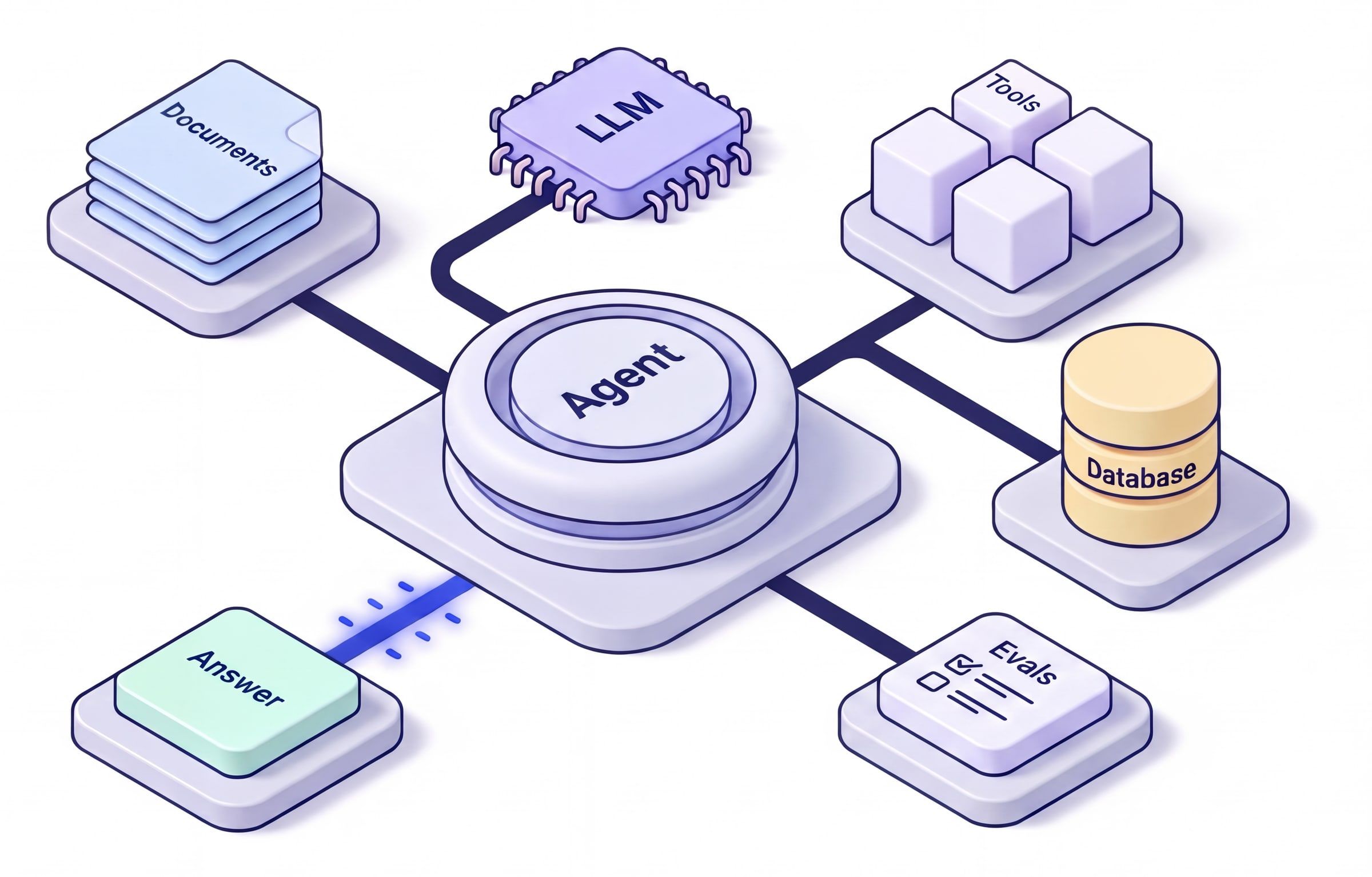
Build AI agents and RAG applications with diagrams, runnable Python code and tests.
17 free courses · 224 lessons
Start here
AI Agent Engineer path
8 steps · about 42 hours of reading, or about 40 hours with LangGraph
Models, structured output and tool calls
Choose the system and define acceptance
- 03
Build agents with one framework
Building Agents with Google ADK 2.0 or Building Agents with LangGraph
- 04
Connect tools through MCP
Retrieve documents and answer with sources
Evaluate application changes
Bound the agent loop and verify its work
Complete the developer knowledge assistant


Start with a lesson
Courses
Foundations and systems
AI Fundamentals
Build the parts of a docs assistant: model requests, context, structured output, document ranking, validated tool calls and evaluations.
Building AI Systems
Choose, measure and improve an AI system against explicit quality, latency, cost and failure requirements.
Build a Small Language Model From Scratch
Build a small one-block transformer, then train it and generate text locally.
LLM Inference Engineering
Implement and inspect inference request handling, cache ownership, scheduling, measurement and capacity decisions using real local runs and clearly bounded experiments.
Building MLOps
Take one user-return prediction application from a manual baseline through reproducible training, local release controls and outcome monitoring.
Agents and frameworks
Building Agents with Google ADK 2.0
Build agents, tools and multi-step workflows with Google ADK 2.0, then evaluate them.
Connecting Agents to Tools and Services with Google ADK 2.0
Connect agents to BigQuery, databases through MCP Toolbox, Agent Search, Google Search and code execution, then add Skills and A2A.
Running and Deploying Agents with Google ADK 2.0
Serve, observe, evaluate and deploy ADK agents with runtime controls, context caching, traces, simulated users, Cloud Run and Agent Runtime.
Building Live and Voice Agents with Google ADK 2.0
Stream audio and screen frames with ADK live agents, handle tools and sessions, test voice callbacks, and build a custom WebSocket bridge.
Building Agents with LangGraph
Build and compare self-contained code-review agents and workflows with LangGraph: tools, stop conditions, context and token budgets, timeouts, checkpoints, idempotent retries, verified outcomes, human approval and memory.
Building, Evaluating, and Deploying Agents with Google Agents CLI
Scaffold, enhance, upgrade, evaluate, deploy, publish and observe ADK agents across the full Google Agents CLI lifecycle.
Retrieval and context
Retrieval-Augmented Generation (RAG)
Search developer docs with LangChain and pgvector, then answer with checked source links.
Context and Memory Engineering for AI Agents
Assemble bounded model requests, compare context policies and maintain scoped memory with explicit provenance, retention and deletion rules.
Building Agentic RAG Applications
Build a documentation assistant that answers from permitted, versioned sources. Learn retrieval, bounded agent decisions, service integration and evaluation through runnable examples.
Tools and evaluation
Model Context Protocol (MCP)
Implement, test and secure MCP servers and clients, from stdio to a remote OAuth-protected service with scoped database access.
LLM Evals
Test LLM features with pytest and DeepEval, measure RAG and tool-call quality per stage, and gate prompt, model and dataset changes on regressions in CI.
Agent Design, Optimization and Harnesses
Choose a control policy, improve it on separated task data and independently verify bounded local actions.