When you need this. A low-concurrency assistant spends most of each decode step moving model weights. A cheaper draft may propose several tokens for one target verification pass. The extra work is worthwhile only when enough draft tokens are accepted.
What you run. Actual probability-correction implementation with explicit vectors, plus an assumed latency model. No draft/target model pair was benchmarked.
This lesson builds on quantize a model and evaluate the regression.
Verify the probability correction
Speculative decoding separates proposal from verification. In the rejection-sampling form taught here, each draft token is accepted using the target and draft probabilities. A rejected position is resampled from the normalized positive part of their difference. Later draft positions are discarded after the first rejection.
The supplied vectors make that probability correction inspectable. Their exact marginal output distribution should match the target distribution. That mathematical property is distinct from reproducing one random token sequence or measuring serving speed.
verify_speculative_draft() implements acceptance, correction, and the all-accepted bonus-token path. marginal_output_distribution() independently checks the distribution in a small vocabulary. The latency sweep is an explicit cost model, not a run of a draft and target LLM.
Run proposal verification
Download the lab from this page, extract it, and run these commands from its directory. The default command reads saved run records or runs the explicitly described local algorithm; it never downloads a model or calls a paid API.
python3 lab.py
python3 -m unittest -v test_lab.py
Read lab.py
from __future__ import annotations

import json
import math

Vector = list[float]


def validate_distribution(values: Vector) -> None:
    if (
        not values
        or any(not math.isfinite(v) or v < 0 for v in values)
        or not math.isclose(math.fsum(values), 1.0, abs_tol=1e-8)
    ):
        raise ValueError("Expected a finite normalized probability distribution")


def residual_distribution(p: Vector, q: Vector) -> Vector:
    """Compute normalized [p(x) - q(x)]_+ required for lossless speculative rejection sampling."""
    validate_distribution(p)
    validate_distribution(q)
    if len(p) != len(q):
        raise ValueError("Vocabulary sizes differ")
    pos = [max(0.0, pv - qv) for pv, qv in zip(p, q)]
    total = sum(pos)
    if total <= 1e-15:
        return list(p)
    return [val / total for val in pos]


def marginal_output_distribution(
    p: Vector, q: Vector, use_residual: bool = True
) -> Vector:
    """Compute the exact marginal probability P(Y = y) of one speculative verification step."""
    validate_distribution(p)
    validate_distribution(q)
    if len(p) != len(q):
        raise ValueError("Vocabulary sizes differ")
    vocab = len(p)
    accepted_mass = [q[y] * min(1.0, p[y] / max(q[y], 1e-15)) for y in range(vocab)]
    reject_prob = 1.0 - sum(accepted_mass)
    resample_dist = residual_distribution(p, q) if use_residual else p
    return [accepted_mass[y] + reject_prob * resample_dist[y] for y in range(vocab)]


def total_variation_distance(p: Vector, q: Vector) -> float:
    return round(0.5 * sum(abs(pv - qv) for pv, qv in zip(p, q)), 8)


def _sample_from_cdf(dist: Vector, u: float) -> int:
    acc = 0.0
    for idx, prob in enumerate(dist):
        acc += prob
        if u < acc:
            return idx
    return len(dist) - 1


def verify_speculative_draft(
    draft_tokens: list[int],
    draft_probs: list[Vector],
    target_probs: list[Vector],
    uniform_draws: list[float],
    resample_draws: list[float],
    use_residual: bool = True,
) -> dict[str, object]:
    """Verify gamma draft tokens in one target pass using lossless rejection sampling.

    - target_probs has length gamma + 1 (positions 0..gamma-1 plus the bonus position gamma).
    - Returns accepted count, emitted token IDs, and step trace.
    """
    gamma = len(draft_tokens)
    if len(draft_probs) != gamma or len(target_probs) != gamma + 1:
        raise ValueError(
            "target_probs must have length gamma + 1 and draft_probs length gamma"
        )

    if len(uniform_draws) != gamma or len(resample_draws) != gamma + 1:
        raise ValueError("Draw counts do not match draft length")
    if any(not 0 <= draw < 1 for draw in uniform_draws + resample_draws):
        raise ValueError("Draws must be in [0,1)")
    for vector in draft_probs + target_probs:
        validate_distribution(vector)
    width = len(target_probs[0])
    if any(len(vector) != width for vector in draft_probs + target_probs):
        raise ValueError("Vocabulary sizes differ")
    if any(
        not 0 <= token < width or draft_probs[i][token] <= 0
        for i, token in enumerate(draft_tokens)
    ):
        raise ValueError("Draft token must have positive proposal probability")
    emitted: list[int] = []
    trace: list[dict[str, object]] = []
    accepted_draft_tokens = 0

    for i in range(gamma):
        tok = draft_tokens[i]
        p_tok = target_probs[i][tok]
        q_tok = max(draft_probs[i][tok], 1e-12)
        accept_ratio = min(1.0, p_tok / q_tok)
        u = uniform_draws[i]

        if u < accept_ratio:
            emitted.append(tok)
            accepted_draft_tokens += 1
            trace.append(
                {
                    "position": i,
                    "draft_token": tok,
                    "p_target": round(p_tok, 4),
                    "q_draft": round(q_tok, 4),
                    "accept_prob": round(accept_ratio, 4),
                    "u_draw": round(u, 4),
                    "outcome": "accepted",
                    "emitted_token": tok,
                }
            )
        else:
            fallback_dist = (
                residual_distribution(target_probs[i], draft_probs[i])
                if use_residual
                else target_probs[i]
            )
            corrected_tok = _sample_from_cdf(fallback_dist, resample_draws[i])
            emitted.append(corrected_tok)
            trace.append(
                {
                    "position": i,
                    "draft_token": tok,
                    "p_target": round(p_tok, 4),
                    "q_draft": round(q_tok, 4),
                    "accept_prob": round(accept_ratio, 4),
                    "u_draw": round(u, 4),
                    "outcome": "rejected_and_resampled",
                    "emitted_token": corrected_tok,
                }
            )
            return {
                "gamma": gamma,
                "accepted_draft_tokens": accepted_draft_tokens,
                "emitted_tokens": emitted,
                "total_emitted": len(emitted),
                "trace": trace,
            }

    # All gamma draft tokens were accepted; sample one bonus token from target_probs[gamma]
    bonus_tok = _sample_from_cdf(target_probs[gamma], resample_draws[-1])
    emitted.append(bonus_tok)
    trace.append(
        {
            "position": gamma,
            "draft_token": None,
            "outcome": "bonus_token_from_target",
            "emitted_token": bonus_tok,
        }
    )
    return {
        "gamma": gamma,
        "accepted_draft_tokens": accepted_draft_tokens,
        "emitted_tokens": emitted,
        "total_emitted": len(emitted),
        "trace": trace,
    }


def expected_tokens_per_step(alpha: float, gamma: int) -> float:
    """Closed-form expected tokens generated per verification step for acceptance rate alpha."""
    if not (0.0 <= alpha <= 1.0):
        raise ValueError("alpha must be in [0, 1]")
    if gamma <= 0:
        raise ValueError("gamma must be positive")
    if abs(1.0 - alpha) < 1e-9:
        return float(gamma + 1)
    return round((1.0 - (alpha ** (gamma + 1))) / (1.0 - alpha), 4)


def estimate_forward_pass_ms(
    num_active_tokens: int,
    base_weight_read_ms: float,
    compute_ms_per_token: float,
    ridge_tokens: int = 48,
) -> float:
    """Piecewise roofline step time for a target or draft forward pass."""
    extra_tokens = max(0, num_active_tokens - ridge_tokens)
    return round(base_weight_read_ms + extra_tokens * compute_ms_per_token, 4)


def speculative_speedup_by_batch(
    gamma: int = 4,
    alphas: tuple[float, ...] = (0.80, 0.45),
    batch_sizes: tuple[int, ...] = (1, 2, 4, 8, 16, 32, 64),
) -> list[dict[str, object]]:
    """Compare standard target decode vs speculative decoding across batch sizes and acceptance rates."""
    # Target 70B FP8 on 2xH100: 22.0 ms weight load, 0.28 ms/token compute above ridge=48
    # Draft 8B FP8 on 2xH100: 2.6 ms weight load, 0.032 ms/token compute above ridge=48
    rows: list[dict[str, object]] = []
    for b in batch_sizes:
        std_step_ms = estimate_forward_pass_ms(
            num_active_tokens=b,
            base_weight_read_ms=22.0,
            compute_ms_per_token=0.42,
            ridge_tokens=32,
        )
        draft_pass_ms = estimate_forward_pass_ms(
            num_active_tokens=b,
            base_weight_read_ms=2.6,
            compute_ms_per_token=0.045,
            ridge_tokens=32,
        )
        verify_tokens = b * (gamma + 1)
        target_verify_ms = estimate_forward_pass_ms(
            num_active_tokens=verify_tokens,
            base_weight_read_ms=22.0,
            compute_ms_per_token=0.42,
            ridge_tokens=32,
        )
        spec_cycle_ms = round(gamma * draft_pass_ms + target_verify_ms, 2)

        row: dict[str, object] = {
            "batch_size": b,
            "verify_batched_tokens": verify_tokens,
            "standard_decode_ms_per_token": round(std_step_ms, 2),
            "spec_cycle_ms": spec_cycle_ms,
        }
        for alpha in alphas:
            exp_tokens = expected_tokens_per_step(alpha, gamma)
            eff_ms_per_tok = round(spec_cycle_ms / exp_tokens, 2)
            speedup = round(std_step_ms / eff_ms_per_tok, 2)
            tag = f"alpha_{int(alpha * 100)}"
            row[f"{tag}_expected_tokens"] = exp_tokens
            row[f"{tag}_ms_per_token"] = eff_ms_per_tok
            row[f"{tag}_speedup"] = speedup
        rows.append(row)
    return rows


def run_verification_demo() -> dict[str, object]:
    # 4-token vocabulary example over gamma = 4 draft positions
    draft_tokens = [0, 1, 2, 1]
    draft_probs = [
        [0.65, 0.20, 0.10, 0.05],
        [0.10, 0.70, 0.15, 0.05],
        [0.05, 0.15, 0.60, 0.20],
        [0.15, 0.55, 0.20, 0.10],
    ]
    target_probs = [
        [0.70, 0.18, 0.08, 0.04],  # pos 0: p(0)=0.70 >= q(0)=0.65 -> accept_prob = 1.0
        [0.12, 0.68, 0.14, 0.06],  # pos 1: p(1)=0.68, q(1)=0.70 -> accept_prob = 0.9714
        [
            0.10,
            0.48,
            0.18,
            0.24,
        ],  # pos 2: p(2)=0.18 < q(2)=0.60 -> accept_prob = 0.30 (rejected!)
        [0.20, 0.50, 0.20, 0.10],  # pos 3: discarded after pos 2 rejection
        [0.25, 0.25, 0.25, 0.25],  # bonus pos 4
    ]
    uniform_draws = [0.42, 0.51, 0.74, 0.19]
    resample_draws = [0.30, 0.30, 0.45, 0.30, 0.30]

    step_result = verify_speculative_draft(
        draft_tokens=draft_tokens,
        draft_probs=draft_probs,
        target_probs=target_probs,
        uniform_draws=uniform_draws,
        resample_draws=resample_draws,
        use_residual=True,
    )

    p_pos2 = target_probs[2]
    q_pos2 = draft_probs[2]
    exact_marginal = marginal_output_distribution(p_pos2, q_pos2, use_residual=True)
    buggy_marginal = marginal_output_distribution(p_pos2, q_pos2, use_residual=False)

    return {
        "verification_step": step_result,
        "distribution_check_pos2": {
            "target_p": p_pos2,
            "draft_q": q_pos2,
            "residual_p_minus_q_norm": [
                round(x, 4) for x in residual_distribution(p_pos2, q_pos2)
            ],
            "tv_distance_with_residual": total_variation_distance(
                p_pos2, exact_marginal
            ),
            "tv_distance_without_residual": total_variation_distance(
                p_pos2, buggy_marginal
            ),
        },
        "batch_crossover": speculative_speedup_by_batch(gamma=4),
    }


def main() -> None:
    report = run_verification_demo()
    print(
        json.dumps(
            {
                "execution_mode": "CPU algorithm with controlled inputs; any latency/capacity coefficients are assumptions",
                **report,
            },
            indent=2,
        )
    )


if __name__ == "__main__":
    main()
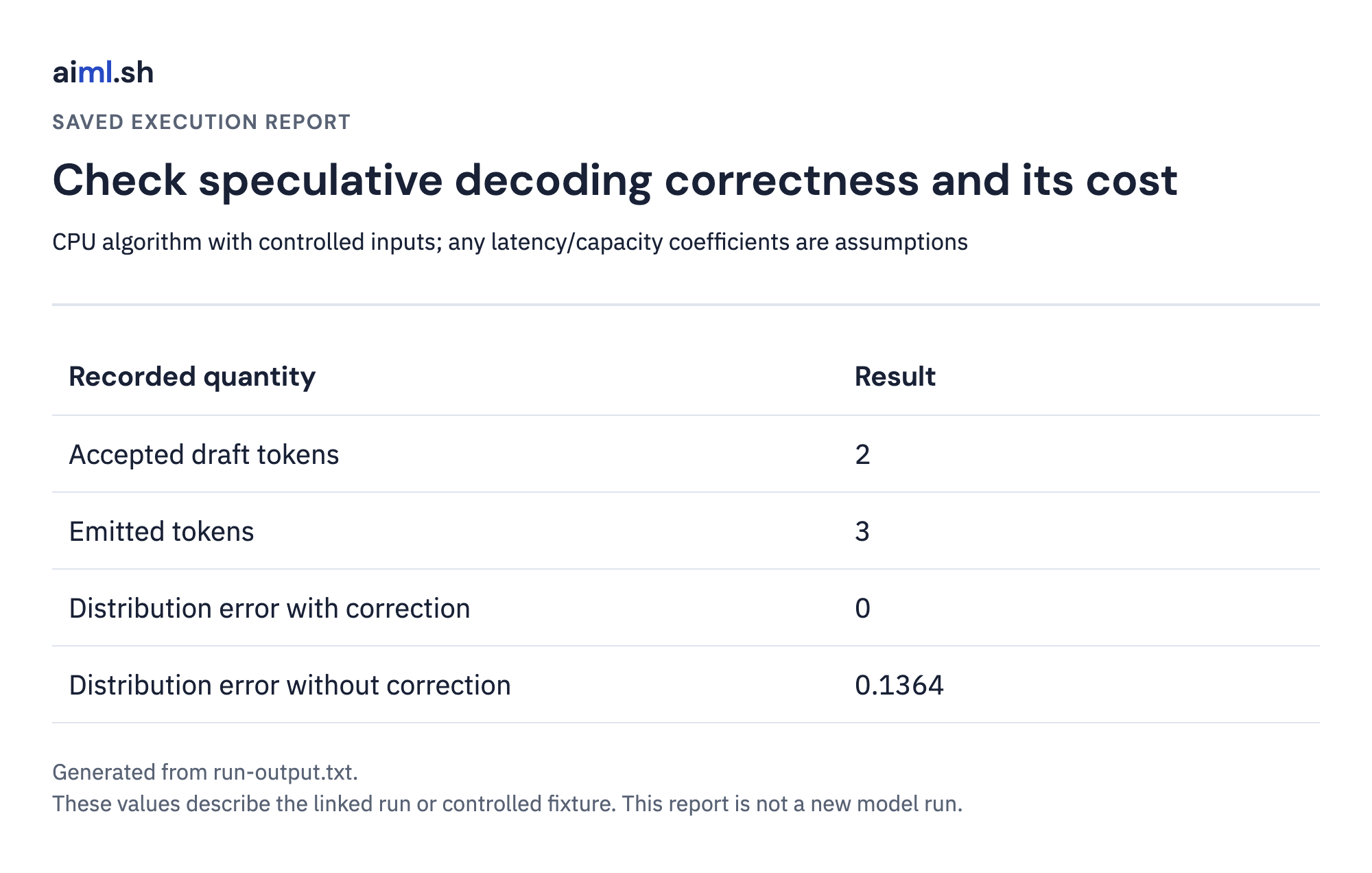
The corrected probability mixture agrees with the target on the supplied vocabulary. Removing the residual correction changes that distribution. This is a correctness check, not a speed measurement or a real draft-model quality result.
| Quantity | Recorded value |
|---|---|
| Accepted draft tokens | 2 |
| Emitted tokens including correction | 3 |
| Corrected distribution difference | 0 |
| Uncorrected distribution difference | 0.1364 |
Inspect the complete local result
{
  "execution_mode": "CPU algorithm with controlled inputs; any latency/capacity coefficients are assumptions",
  "verification_step": {
    "gamma": 4,
    "accepted_draft_tokens": 2,
    "emitted_tokens": [
      0,
      1,
      1
    ],
    "total_emitted": 3,
    "trace": [
      {
        "position": 0,
        "draft_token": 0,
        "p_target": 0.7,
        "q_draft": 0.65,
        "accept_prob": 1.0,
        "u_draw": 0.42,
        "outcome": "accepted",
        "emitted_token": 0
      },
      {
        "position": 1,
        "draft_token": 1,
        "p_target": 0.68,
        "q_draft": 0.7,
        "accept_prob": 0.9714,
        "u_draw": 0.51,
        "outcome": "accepted",
        "emitted_token": 1
      },
      {
        "position": 2,
        "draft_token": 2,
        "p_target": 0.18,
        "q_draft": 0.6,
        "accept_prob": 0.3,
        "u_draw": 0.74,
        "outcome": "rejected_and_resampled",
        "emitted_token": 1
      }
    ]
  },
  "distribution_check_pos2": {
    "target_p": [
      0.1,
      0.48,
      0.18,
      0.24
    ],
    "draft_q": [
      0.05,
      0.15,
      0.6,
      0.2
    ],
    "residual_p_minus_q_norm": [
      0.119,
      0.7857,
      0.0,
      0.0952
    ],
    "tv_distance_with_residual": 0.0,
    "tv_distance_without_residual": 0.1364
  },
  "batch_crossover": [
    {
      "batch_size": 1,
      "verify_batched_tokens": 5,
      "standard_decode_ms_per_token": 22.0,
      "spec_cycle_ms": 32.4,
      "alpha_80_expected_tokens": 3.3616,
      "alpha_80_ms_per_token": 9.64,
      "alpha_80_speedup": 2.28,
      "alpha_45_expected_tokens": 1.7846,
      "alpha_45_ms_per_token": 18.16,
      "alpha_45_speedup": 1.21
    },
    {
      "batch_size": 2,
      "verify_batched_tokens": 10,
      "standard_decode_ms_per_token": 22.0,
      "spec_cycle_ms": 32.4,
      "alpha_80_expected_tokens": 3.3616,
      "alpha_80_ms_per_token": 9.64,
      "alpha_80_speedup": 2.28,
      "alpha_45_expected_tokens": 1.7846,
      "alpha_45_ms_per_token": 18.16,
      "alpha_45_speedup": 1.21
    },
    {
      "batch_size": 4,
      "verify_batched_tokens": 20,
      "standard_decode_ms_per_token": 22.0,
      "spec_cycle_ms": 32.4,
      "alpha_80_expected_tokens": 3.3616,
      "alpha_80_ms_per_token": 9.64,
      "alpha_80_speedup": 2.28,
      "alpha_45_expected_tokens": 1.7846,
      "alpha_45_ms_per_token": 18.16,
      "alpha_45_speedup": 1.21
    },
    {
      "batch_size": 8,
      "verify_batched_tokens": 40,
      "standard_decode_ms_per_token": 22.0,
      "spec_cycle_ms": 35.76,
      "alpha_80_expected_tokens": 3.3616,
      "alpha_80_ms_per_token": 10.64,
      "alpha_80_speedup": 2.07,
      "alpha_45_expected_tokens": 1.7846,
      "alpha_45_ms_per_token": 20.04,
      "alpha_45_speedup": 1.1
    },
    {
      "batch_size": 16,
      "verify_batched_tokens": 80,
      "standard_decode_ms_per_token": 22.0,
      "spec_cycle_ms": 52.56,
      "alpha_80_expected_tokens": 3.3616,
      "alpha_80_ms_per_token": 15.64,
      "alpha_80_speedup": 1.41,
      "alpha_45_expected_tokens": 1.7846,
      "alpha_45_ms_per_token": 29.45,
      "alpha_45_speedup": 0.75
    },
    {
      "batch_size": 32,
      "verify_batched_tokens": 160,
      "standard_decode_ms_per_token": 22.0,
      "spec_cycle_ms": 86.16,
      "alpha_80_expected_tokens": 3.3616,
      "alpha_80_ms_per_token": 25.63,
      "alpha_80_speedup": 0.86,
      "alpha_45_expected_tokens": 1.7846,
      "alpha_45_ms_per_token": 48.28,
      "alpha_45_speedup": 0.46
    },
    {
      "batch_size": 64,
      "verify_batched_tokens": 320,
      "standard_decode_ms_per_token": 35.44,
      "spec_cycle_ms": 159.12,
      "alpha_80_expected_tokens": 3.3616,
      "alpha_80_ms_per_token": 47.33,
      "alpha_80_speedup": 0.75,
      "alpha_45_expected_tokens": 1.7846,
      "alpha_45_ms_per_token": 89.16,
      "alpha_45_speedup": 0.4
    }
  ]
}
This image is an application-generated report of the saved program result, not a new inference run. Open the full-resolution report or read the raw result.
Account for draft and verification work
Longer drafts can amortize target work, but waste more work when acceptance is low. At larger batches, target verification may already be compute-limited, reducing the benefit. Draft cache memory and synchronization add cost. A speedup estimate alone cannot select a production draft model.
Incorrect rejection correction. Replacing residual resampling with ordinary target sampling changes the output marginal in the controlled vocabulary. The correct path preserves the target distribution.
Verification overhead. The cost model includes draft work and verification. At some assumed batch sizes that extra work makes the speculative path slower, despite a correct sampler.
Read the executable checks
from __future__ import annotations

import unittest

from lab import (
    expected_tokens_per_step,
    marginal_output_distribution,
    run_verification_demo,
    speculative_speedup_by_batch,
    total_variation_distance,
)


class TestSpeculativeDecodingLab(unittest.TestCase):
    def test_greedy_threshold_without_residual_breaks_target_distribution(self) -> None:
        p = [0.10, 0.48, 0.18, 0.24]
        q = [0.05, 0.15, 0.60, 0.20]
        exact_marginal = marginal_output_distribution(p, q, use_residual=True)
        buggy_marginal = marginal_output_distribution(p, q, use_residual=False)
        self.assertLessEqual(total_variation_distance(p, exact_marginal), 1e-7)
        self.assertGreater(total_variation_distance(p, buggy_marginal), 0.12)

    def test_high_batch_speculative_verification_slows_down_step_time(self) -> None:
        rows = {row["batch_size"]: row for row in speculative_speedup_by_batch(gamma=4)}
        self.assertGreater(rows[1]["alpha_80_speedup"], 2.0)
        self.assertLess(rows[32]["alpha_80_speedup"], 1.0)
        self.assertLessEqual(rows[64]["alpha_80_speedup"], 0.75)

    def test_rejection_truncates_remaining_draft_and_resamples_residual(self) -> None:
        demo = run_verification_demo()["verification_step"]
        self.assertEqual(demo["accepted_draft_tokens"], 2)
        self.assertEqual(demo["total_emitted"], 3)
        self.assertEqual(demo["emitted_tokens"], [0, 1, 1])

    def test_expected_tokens_formula_matches_boundaries(self) -> None:
        self.assertEqual(expected_tokens_per_step(0.0, 4), 1.0)
        self.assertEqual(expected_tokens_per_step(1.0, 4), 5.0)
        self.assertAlmostEqual(expected_tokens_per_step(0.80, 4), 3.3616, places=4)


class ProbabilityValidationTests(unittest.TestCase):
    def test_invalid_probability_distribution_is_rejected(self):
        from lab import residual_distribution

        for vector in [[0.5, -0.5], [float("nan"), 1], [0.2, 0.2]]:
            with self.assertRaises(ValueError):
                residual_distribution(vector, [0.5, 0.5])

    def test_zero_draw_cannot_select_zero_probability_token(self):
        from lab import _sample_from_cdf

        self.assertEqual(_sample_from_cdf([0, 1], 0), 1)


if __name__ == "__main__":
    unittest.main()


class GuardBoundaryTests(unittest.TestCase):
    def test_rejects_invalid_boundary_inputs_with_specific_reason(self):
        import lab
        cases = [('residual_distribution([1],[0.5,0.5])', 'Vocabulary sizes'), ('marginal_output_distribution([1],[0.5,0.5], use_residual=False)', 'Vocabulary sizes'), ('verify_speculative_draft([0],[],[[1],[1]],[0],[0,0])', 'target_probs must have length'), ('verify_speculative_draft([0],[[1]],[[1],[1]],[],[0,0])', 'Draw counts'), ('verify_speculative_draft([0],[[1]],[[1],[1]],[1],[0,0])', 'Draws must'), ('verify_speculative_draft([0],[[1]],[[0.5,0.5],[1]],[0],[0,0])', 'Vocabulary sizes'), ('verify_speculative_draft([0],[[0,1]],[[0.5,0.5],[0.5,0.5]],[0],[0,0])', 'positive proposal'), ('expected_tokens_per_step(-1,1)', 'alpha must'), ('expected_tokens_per_step(0.5,0)', 'gamma must')]
        for code, reason in cases:
            with self.subTest(code=code):
                with self.assertRaisesRegex((ValueError, MemoryError, KeyError, RuntimeError), reason):
                    exec(code, vars(lab).copy())
Try a change and explain the result
Compare the exact marginal with and without residual resampling. Then vary acceptance and draft length in the cost model. Explain why preserving the target distribution does not guarantee faster responses.
Read the explanation
Correct probability correction preserves the target distribution; speed remains a separate measurement.
Benchmark the actual model pair
Use a supported runtime implementation for real serving. Keep sampling settings and tokenizer compatibility explicit. Measure draft work, acceptance, verification time, memory, and end-to-end latency at the intended concurrency.
References
Sources checked October 24, 2026. Runtime-specific commands and results apply to the recorded versions; linked rolling documentation can change. The application scenarios are teaching examples, not claims about an author’s production incident.