When you need this. A code assistant repeats the same repository instructions and tool schema on many requests. Reusing that prefix can avoid repeated prefill, but sending every request to the same warm replica creates a queue hotspot.
What you run. A radix-tree cache and a routing experiment, both running on CPU, plus a linked comparison in which a real model reuses a cached prefix. No multi-GPU router was deployed.
This lesson builds on balance long-prompt prefill against streaming latency.
Match cached work and current load
Prefix caching reuses attention state for an exact token prefix under the same model and relevant execution configuration. A radix tree organizes shared prefixes, so requests can match a path before extending it. The tree is a data structure; it does not guarantee a speedup in any particular engine.
A cache-aware router weighs saved prefill against waiting behind other requests. Cached state also needs a lifetime: active references pin entries, and eviction must avoid removing state still in use. The local cache tracks token markers; the linked real-model experiment separately reuses actual KV tensors.
RadixKvTree implements prefix matching, insertion, pinning, and eviction. CacheAwareRouter compares affinity and queue-aware choices. The real-model experiment tokenizes the full sequence once and then splits it before caching the prefix. Tokenizing the text pieces separately and joining the results could give a different token sequence.
Why copy the tree before insertion? This teaching implementation snapshots its Python metadata and token markers so a rejected insertion can restore the previous state. Copying the whole tree adds work proportional to its size on each insertion; it is a correctness aid, not a fast serving-engine design. It does not copy model KV tensors. A larger implementation could reserve capacity before committing changes or keep an undo log, then measure the bookkeeping cost.
The tree example starts with sys_prompt. Continuations turn_a and turn_b share that prefix and part of a conversation turn before diverging. Matching that path avoids inserting the same prefix twice; routing still has to compare that saved work with the queue on the replica that owns it.
Keep the shared instructions and tool schema at the start of the prompt and unchanged between requests: the tree matches only an exact token prefix, so one changed token ends the match at that point.
Exercise prefix matching and routing
Download the lab from this page, extract it, and run these commands from its directory. python3 lab.py runs the routing simulation and the radix-tree demo on CPU; it does not download a model or call a paid API.
python3 lab.py
python3 -m unittest -v test_lab.py
Read lab.py
from __future__ import annotations

from dataclasses import dataclass, field
import copy
import json
from typing import Literal


@dataclass
class RadixNode:
    tokens: tuple[int, ...] = ()
    parent: RadixNode | None = None
    children: dict[int, RadixNode] = field(default_factory=dict)
    last_access_step: int = 0
    pin_count: int = 0

    @property
    def is_leaf(self) -> bool:
        return len(self.children) == 0


class RadixKvTree:
    """Compressed radix tree for shared KV-cache prefix blocks with LRU leaf eviction."""

    def __init__(self, max_cached_tokens: int = 16384) -> None:
        if max_cached_tokens <= 0:
            raise ValueError("max_cached_tokens must be positive")
        self.max_cached_tokens = max_cached_tokens
        self.root = RadixNode()
        self.step_clock = 0
        self.cached_tokens = 0
        self.total_evicted_tokens = 0
        self.pinned_sequences = {}

    def _touch(self, node: RadixNode) -> None:
        self.step_clock += 1
        curr: RadixNode | None = node
        while curr is not None and curr is not self.root:
            curr.last_access_step = self.step_clock
            curr = curr.parent

    def match_prefix(self, tokens: tuple[int, ...]) -> tuple[int, RadixNode]:
        """Return (matched_token_count, deepest_matched_node) without mutating tree structure."""
        curr = self.root
        matched = 0
        idx = 0
        n = len(tokens)

        while idx < n:
            first_tok = tokens[idx]
            child = curr.children.get(first_tok)
            if child is None:
                break
            edge = child.tokens
            common = 0
            max_common = min(len(edge), n - idx)
            while common < max_common and edge[common] == tokens[idx + common]:
                common += 1
            if common < len(edge):
                matched += common
                curr = child
                break
            matched += common
            idx += common
            curr = child

        if curr is not self.root:
            self._touch(curr)
        return matched, curr

    def _collect_evictable_leaves(self) -> list[RadixNode]:
        leaves: list[RadixNode] = []
        stack = list(self.root.children.values())
        while stack:
            node = stack.pop()
            if node.is_leaf:
                if node.pin_count == 0:
                    leaves.append(node)
            else:
                stack.extend(node.children.values())
        leaves.sort(key=lambda nd: nd.last_access_step)
        return leaves

    def evict_lru(self, needed_tokens: int) -> int:
        """Evict unpinned leaf nodes in LRU order until needed_tokens are freed."""
        freed = 0
        while freed < needed_tokens:
            leaves = self._collect_evictable_leaves()
            if not leaves:
                raise RuntimeError(
                    f"Cannot evict {needed_tokens} tokens: all remaining cached nodes are pinned"
                )
            victim = leaves[0]
            parent = victim.parent
            assert parent is not None
            del parent.children[victim.tokens[0]]
            victim_len = len(victim.tokens)
            self.cached_tokens -= victim_len
            self.total_evicted_tokens += victim_len
            freed += victim_len
        return freed

    def insert(self, tokens: tuple[int, ...], pin: bool = False) -> dict[str, int]:
        if len(tokens) > self.max_cached_tokens:
            raise ValueError("Request length exceeds replica KV cache capacity")
        snapshot = (
            copy.deepcopy(self.root),
            self.cached_tokens,
            self.total_evicted_tokens,
            self.step_clock,
        )
        try:
            result = self._insert(tokens, pin)
            if pin:
                self.pinned_sequences[tokens] = self.pinned_sequences.get(tokens, 0) + 1
            return result
        except Exception:
            (
                self.root,
                self.cached_tokens,
                self.total_evicted_tokens,
                self.step_clock,
            ) = snapshot
            raise

    def release_pin(self, tokens: tuple[int, ...]) -> None:
        if self.pinned_sequences.get(tokens, 0) < 1:
            raise ValueError("No active pin for this sequence")
        matched, node = self.match_prefix(tokens)
        if matched != len(tokens):
            raise RuntimeError("Pinned sequence is missing")
        while node is not self.root:
            node.pin_count -= 1
            node = node.parent
        self.pinned_sequences[tokens] -= 1
        if self.pinned_sequences[tokens] == 0:
            del self.pinned_sequences[tokens]

    def _insert(self, tokens: tuple[int, ...], pin: bool = False) -> dict[str, int]:
        """Insert a token sequence into the radix tree, splitting edges on partial match."""
        curr = self.root
        idx = 0
        n = len(tokens)
        matched_tokens = 0

        while idx < n:
            first_tok = tokens[idx]
            child = curr.children.get(first_tok)
            if child is None:
                break
            edge = child.tokens
            common = 0
            max_common = min(len(edge), n - idx)
            while common < max_common and edge[common] == tokens[idx + common]:
                common += 1
            matched_tokens += common
            idx += common

            if common == len(edge):
                curr = child
            else:
                # Split child edge into shared prefix node and existing suffix child
                split_node = RadixNode(
                    tokens=edge[:common],
                    parent=curr,
                    last_access_step=child.last_access_step,
                    pin_count=child.pin_count,
                )
                curr.children[first_tok] = split_node
                child.tokens = edge[common:]
                child.parent = split_node
                split_node.children[child.tokens[0]] = child
                curr = split_node
                break

        new_tokens = n - idx
        if new_tokens > 0:
            overflow = (self.cached_tokens + new_tokens) - self.max_cached_tokens
            if overflow > 0:
                # The matched path is a dependency of this insertion, even when otherwise unpinned.
                protected = []
                node = curr
                while node is not self.root:
                    node.pin_count += 1
                    protected.append(node)
                    node = node.parent
                try:
                    self.evict_lru(overflow)
                finally:
                    for node in protected:
                        node.pin_count -= 1
            new_leaf = RadixNode(
                tokens=tokens[idx:],
                parent=curr,
                last_access_step=self.step_clock + 1,
            )
            curr.children[new_leaf.tokens[0]] = new_leaf
            self.cached_tokens += new_tokens
            curr = new_leaf

        if pin:
            node_ptr: RadixNode | None = curr
            while node_ptr is not None and node_ptr is not self.root:
                node_ptr.pin_count += 1
                node_ptr = node_ptr.parent

        self._touch(curr)
        return {
            "matched_tokens": matched_tokens,
            "new_tokens": new_tokens,
            "cached_tokens": self.cached_tokens,
        }


@dataclass
class GpuReplica:
    replica_id: int
    tree: RadixKvTree
    queue_wait_ms: float = 0.0
    routed_requests: int = 0
    matched_tokens_total: int = 0
    computed_tokens_total: int = 0


class CacheAwareRouter:
    """Routes incoming prompts across GPU replicas using round-robin, pure affinity, or cache-aware scoring."""

    def __init__(
        self,
        num_replicas: int = 4,
        max_cached_tokens_per_replica: int = 16384,
        prefill_ms_per_token: float = 0.025,
        cached_lookup_ms_per_token: float = 0.0015,
        queue_decay_ms_per_arrival: float = 12.0,
    ) -> None:
        self.replicas = [
            GpuReplica(
                replica_id=i,
                tree=RadixKvTree(max_cached_tokens=max_cached_tokens_per_replica),
            )
            for i in range(num_replicas)
        ]
        self.prefill_ms_per_token = prefill_ms_per_token
        self.cached_lookup_ms_per_token = cached_lookup_ms_per_token
        self.queue_decay_ms_per_arrival = queue_decay_ms_per_arrival
        self._rr_cursor = 0

    def _estimate_prefill_ms(self, total_tokens: int, matched_tokens: int) -> float:
        unmatched = total_tokens - matched_tokens
        return round(
            matched_tokens * self.cached_lookup_ms_per_token
            + unmatched * self.prefill_ms_per_token,
            4,
        )

    def route_request(
        self,
        tokens: tuple[int, ...],
        policy: Literal["round_robin", "pure_affinity", "cache_aware"],
    ) -> dict[str, object]:
        for rep in self.replicas:
            rep.queue_wait_ms = max(
                0.0, round(rep.queue_wait_ms - self.queue_decay_ms_per_arrival, 4)
            )

        if policy == "round_robin":
            chosen = self.replicas[self._rr_cursor % len(self.replicas)]
            self._rr_cursor += 1
        elif policy == "pure_affinity":
            # Pick replica with longest prefix match; ties go to lowest replica_id (ignoring queue load)
            best_rep = self.replicas[0]
            best_match = -1
            for rep in self.replicas:
                matched, _ = rep.tree.match_prefix(tokens)
                if matched > best_match:
                    best_match = matched
                    best_rep = rep
            if best_match == 0:
                # Hash by first token so same prefix always lands on the same replica
                chosen = self.replicas[tokens[0] % len(self.replicas)]
            else:
                chosen = best_rep
        elif policy == "cache_aware":
            # Choose replica that minimizes estimated TTFT = queue_wait_ms + remaining_prefill_ms
            chosen = min(
                self.replicas,
                key=lambda rep: (
                    round(
                        rep.queue_wait_ms
                        + self._estimate_prefill_ms(
                            len(tokens), rep.tree.match_prefix(tokens)[0]
                        ),
                        4,
                    ),
                    rep.replica_id,
                ),
            )
        else:
            raise ValueError(f"Unknown routing policy: {policy}")

        matched, _ = chosen.tree.match_prefix(tokens)
        exec_ms = self._estimate_prefill_ms(len(tokens), matched)
        ttft_ms = round(chosen.queue_wait_ms + exec_ms, 2)

        chosen.tree.insert(tokens)
        chosen.queue_wait_ms = round(chosen.queue_wait_ms + exec_ms, 4)
        chosen.routed_requests += 1
        chosen.matched_tokens_total += matched
        chosen.computed_tokens_total += len(tokens) - matched

        return {
            "replica_id": chosen.replica_id,
            "matched_tokens": matched,
            "computed_tokens": len(tokens) - matched,
            "exec_ms": round(exec_ms, 2),
            "ttft_ms": ttft_ms,
        }


def build_burst_workload() -> list[tuple[int, ...]]:
    """Four 4,096-token tenant system prompts plus a 16-request traffic spike on tenant 0."""
    tenant_prefixes = [
        tuple(range(10_000 * (t + 1), 10_000 * (t + 1) + 4096)) for t in range(4)
    ]
    requests: list[tuple[int, ...]] = []
    # Phase 1: interleaved multi-tenant traffic across all 4 tenants (16 requests)
    for step in range(16):
        t_idx = (step * 3 + 1) % 4
        user_suffix = tuple(range(100_000 + step * 256, 100_000 + (step + 1) * 256))
        requests.append(tenant_prefixes[t_idx] + user_suffix)
    # Phase 2: burst of 16 requests on tenant 0
    for burst in range(16):
        user_suffix = tuple(range(200_000 + burst * 256, 200_000 + (burst + 1) * 256))
        requests.append(tenant_prefixes[0] + user_suffix)
    return requests


def simulate_routing_comparison() -> dict[str, object]:
    workload = build_burst_workload()
    policies: list[Literal["round_robin", "pure_affinity", "cache_aware"]] = [
        "round_robin",
        "pure_affinity",
        "cache_aware",
    ]
    results: dict[str, dict[str, object]] = {}

    for policy in policies:
        router = CacheAwareRouter(
            num_replicas=4,
            max_cached_tokens_per_replica=9216,
            prefill_ms_per_token=0.025,
            cached_lookup_ms_per_token=0.0015,
            queue_decay_ms_per_arrival=14.0,
        )
        ttfts: list[float] = []
        for req_tokens in workload:
            out = router.route_request(req_tokens, policy=policy)
            ttfts.append(float(out["ttft_ms"]))

        total_matched = sum(r.matched_tokens_total for r in router.replicas)
        total_computed = sum(r.computed_tokens_total for r in router.replicas)
        total_tokens = total_matched + total_computed
        results[policy] = {
            "policy": policy,
            "total_requests": len(workload),
            "cache_hit_ratio": round(total_matched / total_tokens, 4),
            "mean_ttft_ms": round(sum(ttfts) / len(ttfts), 2),
            "max_ttft_ms": round(max(ttfts), 2),
            "max_replica_requests": max(r.routed_requests for r in router.replicas),
            "min_replica_requests": min(r.routed_requests for r in router.replicas),
            "total_evicted_tokens": sum(
                r.tree.total_evicted_tokens for r in router.replicas
            ),
            "replica_loads": [
                {
                    "replica_id": r.replica_id,
                    "routed_requests": r.routed_requests,
                    "cached_tokens": r.tree.cached_tokens,
                    "evicted_tokens": r.tree.total_evicted_tokens,
                }
                for r in router.replicas
            ],
        }

    # Also record a small radix tree trace showing shared prefix + branching + LRU eviction
    demo_tree = RadixKvTree(max_cached_tokens=16)
    sys_prompt = (10, 11, 12, 13)
    turn_a = sys_prompt + (20, 21, 22, 23)
    turn_b = sys_prompt + (20, 21, 30, 31)
    first_insert = demo_tree.insert(turn_a, pin=False)
    second_insert = demo_tree.insert(turn_b, pin=False)

    return {
        "workload_requests": len(workload),
        "hot_prefix_tokens": 4096,
        "user_turn_tokens": 256,
        "radix_split_demo": {
            "first_insert": first_insert,
            "second_insert": second_insert,
        },
        "policies": results,
    }


def main() -> None:
    report = simulate_routing_comparison()
    print(
        json.dumps(
            {
                "execution_mode": "CPU algorithm with controlled inputs; any latency/capacity coefficients are assumptions",
                **report,
            },
            indent=2,
        )
    )


if __name__ == "__main__":
    main()
The tree experiment checks matching, ownership, and eviction. The real prefix-reuse result from the first lesson also compares logits and the next greedy token after reusing actual attention state. The routing simulation uses assumed latency and capacity coefficients, so compare the three policies with each other rather than reading the milliseconds as hardware timings.
Inspect the complete local result
{
  "execution_mode": "CPU algorithm with controlled inputs; any latency/capacity coefficients are assumptions",
  "workload_requests": 32,
  "hot_prefix_tokens": 4096,
  "user_turn_tokens": 256,
  "radix_split_demo": {
    "first_insert": {
      "matched_tokens": 0,
      "new_tokens": 8,
      "cached_tokens": 8
    },
    "second_insert": {
      "matched_tokens": 6,
      "new_tokens": 2,
      "cached_tokens": 10
    }
  },
  "policies": {
    "round_robin": {
      "policy": "round_robin",
      "total_requests": 32,
      "cache_hit_ratio": 0.7353,
      "mean_ttft_ms": 47.19,
      "max_ttft_ms": 108.8,
      "max_replica_requests": 8,
      "min_replica_requests": 8,
      "total_evicted_tokens": 3072,
      "replica_loads": [
        {
          "replica_id": 0,
          "routed_requests": 8,
          "cached_tokens": 9216,
          "evicted_tokens": 1024
        },
        {
          "replica_id": 1,
          "routed_requests": 8,
          "cached_tokens": 6144,
          "evicted_tokens": 0
        },
        {
          "replica_id": 2,
          "routed_requests": 8,
          "cached_tokens": 9216,
          "evicted_tokens": 1024
        },
        {
          "replica_id": 3,
          "routed_requests": 8,
          "cached_tokens": 9216,
          "evicted_tokens": 1024
        }
      ]
    },
    "pure_affinity": {
      "policy": "pure_affinity",
      "total_requests": 32,
      "cache_hit_ratio": 0.4412,
      "mean_ttft_ms": 1217.24,
      "max_ttft_ms": 1625.6,
      "max_replica_requests": 32,
      "min_replica_requests": 0,
      "total_evicted_tokens": 69632,
      "replica_loads": [
        {
          "replica_id": 0,
          "routed_requests": 32,
          "cached_tokens": 8192,
          "evicted_tokens": 69632
        },
        {
          "replica_id": 1,
          "routed_requests": 0,
          "cached_tokens": 0,
          "evicted_tokens": 0
        },
        {
          "replica_id": 2,
          "routed_requests": 0,
          "cached_tokens": 0,
          "evicted_tokens": 0
        },
        {
          "replica_id": 3,
          "routed_requests": 0,
          "cached_tokens": 0,
          "evicted_tokens": 0
        }
      ]
    },
    "cache_aware": {
      "policy": "cache_aware",
      "total_requests": 32,
      "cache_hit_ratio": 0.8235,
      "mean_ttft_ms": 32.34,
      "max_ttft_ms": 108.8,
      "max_replica_requests": 20,
      "min_replica_requests": 4,
      "total_evicted_tokens": 0,
      "replica_loads": [
        {
          "replica_id": 0,
          "routed_requests": 4,
          "cached_tokens": 5120,
          "evicted_tokens": 0
        },
        {
          "replica_id": 1,
          "routed_requests": 20,
          "cached_tokens": 9216,
          "evicted_tokens": 0
        },
        {
          "replica_id": 2,
          "routed_requests": 4,
          "cached_tokens": 5120,
          "evicted_tokens": 0
        },
        {
          "replica_id": 3,
          "routed_requests": 4,
          "cached_tokens": 5120,
          "evicted_tokens": 0
        }
      ]
    }
  }
}
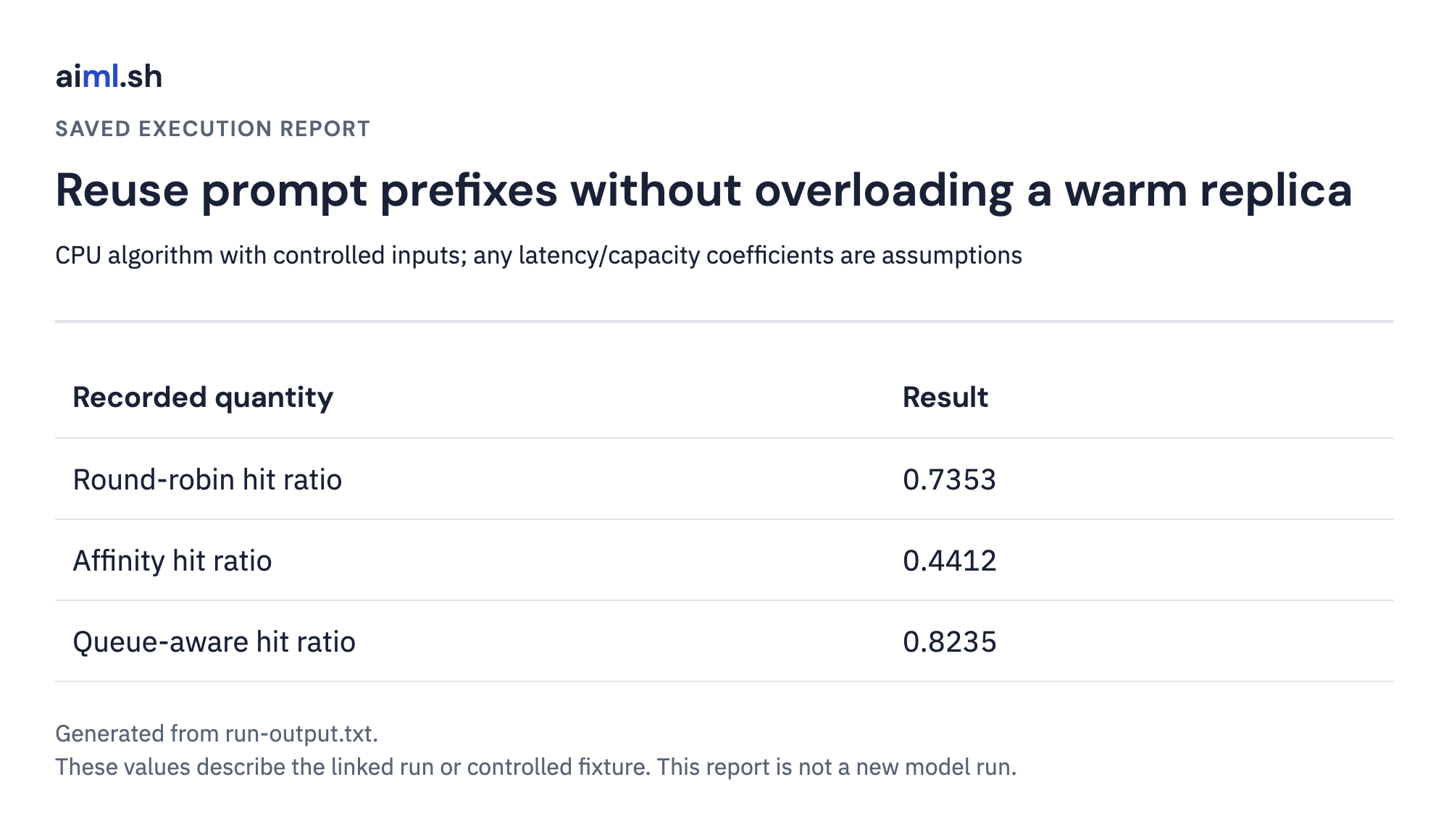
This image renders the saved result in run-output.txt; it is not a new run. Open the full-resolution report or read the raw result.
Trade cache hits against queue wait
Higher cache hit rate can coexist with worse end-to-end latency. Routing to a colder but less busy replica can be faster. Cross-tenant reuse also needs an isolation policy and model/configuration identity; token equality alone is not an authorization check.
Pinned cache state. If evicting every unpinned entry still cannot free enough room, insert raises RuntimeError and restores the previous tree. While insert extends a prefix, it temporarily protects the matched path so it cannot evict that prefix.
Affinity hotspot. In the routing fixture, pure_affinity sends each request to the replica with the longest prefix match (or, with no match, picks a replica from the first token) and ignores queue length, so one replica receives every request and its queue grows. cache_aware picks the replica with the lowest estimated queue wait plus remaining prefill.
Read the executable checks
from __future__ import annotations

import unittest

from lab import (
    CacheAwareRouter,
    RadixKvTree,
    simulate_routing_comparison,
)


class TestPrefixCacheAndRouterLab(unittest.TestCase):
    def test_evicting_pinned_prefix_node_raises_or_skips(self) -> None:
        tree = RadixKvTree(max_cached_tokens=8)
        tree.insert((1, 2, 3, 4, 5, 6), pin=True)
        with self.assertRaises(RuntimeError):
            tree.insert((10, 11, 12, 13))

    def test_blind_prefix_affinity_overloads_single_replica(self) -> None:
        report = simulate_routing_comparison()
        pure = report["policies"]["pure_affinity"]
        aware = report["policies"]["cache_aware"]
        self.assertGreater(pure["max_ttft_ms"], aware["max_ttft_ms"] * 2.0)
        self.assertGreaterEqual(pure["max_replica_requests"], 24)

    def test_radix_tree_splits_shared_edge_on_divergent_branch(self) -> None:
        tree = RadixKvTree(max_cached_tokens=32)
        tree.insert((1, 2, 3, 4, 5, 6))
        second = tree.insert((1, 2, 3, 4, 9, 10))
        self.assertEqual(second["matched_tokens"], 4)
        self.assertEqual(second["new_tokens"], 2)
        self.assertEqual(tree.cached_tokens, 8)

    def test_lru_evicts_oldest_unpinned_leaf_first(self) -> None:
        tree = RadixKvTree(max_cached_tokens=10)
        tree.insert((1, 2, 3, 4))
        tree.insert((5, 6, 7, 8))
        # Touch (1, 2, 3, 4) so (5, 6, 7, 8) becomes the oldest leaf
        matched, _ = tree.match_prefix((1, 2, 3, 4))
        self.assertEqual(matched, 4)
        tree.insert((9, 10, 11, 12))
        self.assertEqual(tree.match_prefix((1, 2, 3, 4))[0], 4)
        self.assertEqual(tree.match_prefix((5, 6, 7, 8))[0], 0)

    def test_cache_aware_router_beats_round_robin_and_pure_affinity(self) -> None:
        report = simulate_routing_comparison()
        rr = report["policies"]["round_robin"]
        pure = report["policies"]["pure_affinity"]
        aware = report["policies"]["cache_aware"]
        self.assertLess(aware["mean_ttft_ms"], rr["mean_ttft_ms"])
        self.assertLess(aware["mean_ttft_ms"], pure["mean_ttft_ms"])


class PrefixInsertionRegressions(unittest.TestCase):
    def test_extending_prefix_does_not_evict_its_ancestor(self):
        tree = RadixKvTree(10)
        tree.insert((1, 2, 3, 4, 5, 6))
        tree.insert((20, 21, 22, 23))
        tree.insert((1, 2, 3, 4, 5, 6, 7, 8))
        self.assertEqual(tree.match_prefix((1, 2, 3, 4, 5, 6, 7, 8))[0], 8)
        self.assertLessEqual(tree.cached_tokens, 10)

    def test_partial_edge_is_a_prefix_match(self):
        tree = RadixKvTree(10)
        tree.insert((1, 2, 3, 4))
        self.assertEqual(tree.match_prefix((1, 2, 3))[0], 3)

    def test_failed_insert_leaves_existing_branches_intact(self):
        tree = RadixKvTree(10)
        tree.insert((1, 2, 3, 4, 5, 6), pin=True)
        tree.insert((20, 21, 22, 23), pin=True)
        with self.assertRaises(RuntimeError):
            tree.insert((1, 2, 3, 4, 9, 10, 11, 12))
        self.assertEqual(tree.match_prefix((1, 2, 3, 4, 5, 6))[0], 6)
        self.assertEqual(tree.match_prefix((20, 21, 22, 23))[0], 4)
        self.assertEqual(tree.cached_tokens, 10)

    def test_oversized_shared_sequence_is_rejected_before_mutation(self):
        tree = RadixKvTree(6)
        tree.insert((1, 2, 3, 4))
        with self.assertRaises(ValueError):
            tree.insert((1, 2, 3, 4, 5, 6, 7))
        self.assertEqual(tree.match_prefix((1, 2, 3, 4))[0], 4)


class PinLifetimeTests(unittest.TestCase):
    def test_released_pin_can_be_evicted(self):
        tree = RadixKvTree(6)
        tree.insert((1, 2, 3, 4), pin=True)
        tree.release_pin((1, 2, 3, 4))
        tree.insert((5, 6, 7, 8))
        self.assertEqual(tree.match_prefix((1, 2, 3, 4))[0], 0)

    def test_unowned_pin_cannot_be_released(self):
        tree = RadixKvTree(6)
        tree.insert((1, 2, 3))
        with self.assertRaises(ValueError):
            tree.release_pin((1, 2, 3))


if __name__ == "__main__":
    unittest.main()


class GuardBoundaryTests(unittest.TestCase):
    def test_rejects_invalid_boundary_inputs_with_specific_reason(self):
        import lab
        cases = [('RadixKvTree(0)', 'max_cached_tokens'), ('a=RadixKvTree(4)\na.insert((1,),pin=True)\na.root.children.clear()\na.release_pin((1,))', 'Pinned sequence'), ('CacheAwareRouter().route_request((1,),"bad")', 'Unknown routing')]
        for code, reason in cases:
            with self.subTest(code=code):
                with self.assertRaisesRegex((ValueError, MemoryError, KeyError, RuntimeError), reason):
                    exec(code, vars(lab).copy())
Try a change and explain the result
Create a burst for one shared prefix and compare affinity-only with queue-aware routing. Inspect evictions while a prefix is pinned. In the real record, compare the final logits and next token after cold and prefix-reused processing.
Read the explanation
A hit is useful only when the saved work outweighs the added queue and other costs.
Isolate and invalidate cached state
Include model revision, adapters, prompt/template changes, and tenant isolation in cache identity. Invalidate stale state deliberately. Report time to first token next to hit rate; a high hit rate alone does not show that serving got faster.
References
Sources checked October 24, 2026. Runtime-specific commands and results apply to the recorded versions; linked rolling documentation can change.