When you need this. A completion batch contains one long response and several short ones. Waiting for every member to finish holds short requests and queued work behind the longest output. Implement a scheduler that revisits membership after each decode iteration.
What you run. Executable discrete-event scheduler with a deterministic cost model. Real static-batch model measurements are linked separately; no engine integration is claimed.
This lesson builds on explain tiled attention and verify its output.
Revisit admission after each iteration
A static batch retains its original membership until the batch finishes. Continuous batching can release completed sequences and admit queued requests at iteration boundaries. The active batch therefore changes over time. A fixed batch can still stream a completed short response; it is the reserved execution slot that remains unavailable to waiting work. Both model policies use the same packed-prefill cost assumption.
The scheduler must track arrival time, remaining output work, completion, and available slots. Padding waste and queue delay are separate: eliminating padded work does not remove the time a request waits for capacity. The lab uses a deterministic decode-cost function so you can inspect these scheduling decisions.
ContinuousBatchScheduler handles admission and completion events, while StaticBatchRunner provides a baseline on the same request trace. The real-model batch sweep in the first lesson is static batching; it does not show this scheduler integrated into the model engine.
Run the scheduling experiment
Download the lab from this page, extract it, and run these commands from its directory. The default command reads saved run records or runs the explicitly described local algorithm; it never downloads a model or calls a paid API.
python3 lab.py
python3 -m unittest -v test_lab.py
Read lab.py
"""Discrete-event simulator comparing static padded batching vs continuous batching."""

from __future__ import annotations

from dataclasses import dataclass
import json
import math


@dataclass(frozen=True)
class InferenceRequest:
    req_id: str
    arrival_ms: float
    prompt_tokens: int
    output_tokens: int


@dataclass
class CompletedRequest:
    req_id: str
    arrival_ms: float
    start_ms: float
    completion_ms: float
    prompt_tokens: int
    output_tokens: int

    @property
    def queue_delay_ms(self) -> float:
        return self.start_ms - self.arrival_ms

    @property
    def e2e_latency_ms(self) -> float:
        return self.completion_ms - self.arrival_ms


def percentile(values: list[float], p: float) -> float:
    if not values:
        return 0.0
    ordered = sorted(values)
    idx = min(len(ordered) - 1, max(0, math.ceil((p / 100.0) * len(ordered)) - 1))
    return ordered[idx]


class StaticBatchRunner:
    """Locks a batch of up to max_batch_size requests until the longest output finishes."""

    def __init__(
        self,
        max_batch_size: int = 4,
        prefill_ms_per_token: float = 0.08,
        decode_step_ms: float = 12.0,
    ) -> None:
        self.max_batch_size = max_batch_size
        self.prefill_ms_per_token = prefill_ms_per_token
        self.decode_step_ms = decode_step_ms

    def run(self, requests: list[InferenceRequest]) -> dict[str, object]:
        pending = sorted(requests, key=lambda r: r.arrival_ms)
        clock_ms = 0.0
        completed: list[CompletedRequest] = []
        wasted_pad_token_steps = 0
        valid_token_steps = 0

        for idx in range(0, len(pending), self.max_batch_size):
            batch = pending[idx : idx + self.max_batch_size]
            latest_arrival = max(r.arrival_ms for r in batch)
            clock_ms = max(clock_ms, latest_arrival)
            batch_start_ms = clock_ms

            # Both policies use the same packed-prefill cost assumption.
            prefill_duration_ms = (
                sum(r.prompt_tokens for r in batch) * self.prefill_ms_per_token
            )
            clock_ms += prefill_duration_ms

            # Decode until the longest sequence in the batch emits EOS
            max_output = max(r.output_tokens for r in batch)
            decode_duration_ms = (max_output - 1) * self.decode_step_ms
            clock_ms += decode_duration_ms

            for r in batch:
                valid_token_steps += r.output_tokens
                wasted_pad_token_steps += max_output - r.output_tokens
                completed.append(
                    CompletedRequest(
                        req_id=r.req_id,
                        arrival_ms=r.arrival_ms,
                        start_ms=batch_start_ms,
                        completion_ms=batch_start_ms
                        + prefill_duration_ms
                        + (r.output_tokens - 1) * self.decode_step_ms,
                        prompt_tokens=r.prompt_tokens,
                        output_tokens=r.output_tokens,
                    )
                )

        return _summarize_run(
            mode="static_batching",
            completed=completed,
            total_elapsed_ms=clock_ms,
            valid_token_steps=valid_token_steps,
            wasted_pad_token_steps=wasted_pad_token_steps,
        )


class ContinuousBatchScheduler:
    """Iteration-level scheduler: finished sequences exit each step and waiting requests join."""

    def __init__(
        self,
        max_batch_size: int = 4,
        max_kv_tokens: int = 8192,
        prefill_ms_per_token: float = 0.08,
        decode_step_ms: float = 12.0,
        enforce_kv_limit: bool = True,
    ) -> None:
        self.max_batch_size = max_batch_size
        self.max_kv_tokens = max_kv_tokens
        self.prefill_ms_per_token = prefill_ms_per_token
        self.decode_step_ms = decode_step_ms
        self.enforce_kv_limit = enforce_kv_limit

    def run(self, requests: list[InferenceRequest]) -> dict[str, object]:
        if not requests or self.max_batch_size < 1 or self.max_kv_tokens < 1:
            raise ValueError("Requests and capacities must be positive")
        if any(
            q.prompt_tokens < 1 or q.output_tokens < 1 or q.arrival_ms < 0
            for q in requests
        ):
            raise ValueError("Invalid request shape")
        waiting = sorted(requests, key=lambda q: q.arrival_ms)
        active = []
        completed = []
        clock_ms = 0.0
        valid_token_steps = 0
        peak_kv_tokens = 0

        def finish_done():
            nonlocal active
            keep = []
            for slot in active:
                q = slot["req"]
                if slot["remaining"] == 0:
                    completed.append(
                        CompletedRequest(
                            q.req_id,
                            q.arrival_ms,
                            slot["start_ms"],
                            clock_ms,
                            q.prompt_tokens,
                            q.output_tokens,
                        )
                    )
                else:
                    keep.append(slot)
            active = keep

        while waiting or active:
            if not active and waiting:
                clock_ms = max(clock_ms, waiting[0].arrival_ms)
            admitted = []
            reserved = sum(s["kv_tokens"] + s["remaining"] for s in active)
            while (
                waiting
                and len(active) < self.max_batch_size
                and waiting[0].arrival_ms <= clock_ms
            ):
                q = waiting[0]
                need = q.prompt_tokens + q.output_tokens - 1
                if self.enforce_kv_limit and reserved + need > self.max_kv_tokens:
                    if not active:
                        raise MemoryError("Request exceeds total KV capacity")
                    break
                waiting.pop(0)
                reserved += need
                slot = {
                    "req": q,
                    "start_ms": clock_ms,
                    "remaining": q.output_tokens - 1,
                    "kv_tokens": q.prompt_tokens,
                }
                active.append(slot)
                admitted.append(slot)
            if admitted:
                clock_ms += (
                    sum(s["req"].prompt_tokens for s in admitted)
                    * self.prefill_ms_per_token
                )
                valid_token_steps += len(
                    admitted
                )  # prefill supplies the first output token
                peak_kv_tokens = max(
                    peak_kv_tokens, sum(s["kv_tokens"] for s in active)
                )
                finish_done()
            if active:
                clock_ms += self.decode_step_ms
                for slot in active:
                    slot["remaining"] -= 1
                    slot["kv_tokens"] += 1
                    valid_token_steps += 1
                peak_kv_tokens = max(
                    peak_kv_tokens, sum(s["kv_tokens"] for s in active)
                )
                if peak_kv_tokens > self.max_kv_tokens:
                    raise MemoryError("Active KV tokens exceeded max_kv_tokens")
                finish_done()
        summary = _summarize_run(
            "continuous_batching", completed, clock_ms, valid_token_steps, 0
        )
        summary["peak_kv_tokens"] = peak_kv_tokens
        return summary


def _summarize_run(
    mode: str,
    completed: list[CompletedRequest],
    total_elapsed_ms: float,
    valid_token_steps: int,
    wasted_pad_token_steps: int,
) -> dict[str, object]:
    queue_delays = [c.queue_delay_ms for c in completed]
    e2e_latencies = [c.e2e_latency_ms for c in completed]
    short_e2e = [c.e2e_latency_ms for c in completed if c.output_tokens <= 64]
    total_steps = valid_token_steps + wasted_pad_token_steps
    effective_tps = valid_token_steps / (total_elapsed_ms / 1000.0)
    return {
        "mode": mode,
        "requests_completed": len(completed),
        "total_elapsed_ms": round(total_elapsed_ms, 2),
        "valid_output_tokens": valid_token_steps,
        "wasted_pad_token_steps": wasted_pad_token_steps,
        "pad_waste_ratio": round(wasted_pad_token_steps / total_steps, 4)
        if total_steps
        else 0.0,
        "avg_queue_delay_ms": round(sum(queue_delays) / len(queue_delays), 2),
        "avg_short_request_e2e_ms": round(sum(short_e2e) / len(short_e2e), 2)
        if short_e2e
        else 0.0,
        "p50_e2e_latency_ms": round(percentile(e2e_latencies, 50), 2),
        "p95_e2e_latency_ms": round(percentile(e2e_latencies, 95), 2),
        "effective_tokens_per_sec": round(effective_tps, 2),
        "per_request": [
            {
                "req_id": c.req_id,
                "output_tokens": c.output_tokens,
                "queue_delay_ms": round(c.queue_delay_ms, 2),
                "e2e_latency_ms": round(c.e2e_latency_ms, 2),
            }
            for c in sorted(completed, key=lambda x: x.req_id)
        ],
    }


def make_heterogeneous_workload() -> list[InferenceRequest]:
    """12 requests mixing short chat replies (32-64 tokens) with long generations (512 tokens)."""
    specs = [
        ("req-01", 0.0, 256, 512),
        ("req-02", 0.0, 128, 32),
        ("req-03", 0.0, 128, 48),
        ("req-04", 0.0, 128, 64),
        ("req-05", 60.0, 192, 48),
        ("req-06", 120.0, 128, 32),
        ("req-07", 180.0, 256, 512),
        ("req-08", 240.0, 128, 64),
        ("req-09", 300.0, 160, 48),
        ("req-10", 360.0, 128, 32),
        ("req-11", 420.0, 192, 64),
        ("req-12", 480.0, 128, 48),
    ]
    return [InferenceRequest(*s) for s in specs]


def compare_batching_modes() -> dict[str, object]:
    workload = make_heterogeneous_workload()
    static_res = StaticBatchRunner(max_batch_size=4).run(workload)
    cont_res = ContinuousBatchScheduler(max_batch_size=4, max_kv_tokens=4096).run(
        workload
    )
    return {
        "workload_summary": {
            "num_requests": len(workload),
            "max_batch_size": 4,
            "total_generated_tokens": sum(r.output_tokens for r in workload),
        },
        "static_batching": static_res,
        "continuous_batching": cont_res,
        "speedup_metrics": {
            "throughput_gain_x": round(
                float(cont_res["effective_tokens_per_sec"])
                / float(static_res["effective_tokens_per_sec"]),
                2,
            ),
            "short_request_latency_reduction_x": round(
                float(static_res["avg_short_request_e2e_ms"])
                / float(cont_res["avg_short_request_e2e_ms"]),
                2,
            ),
            "p95_latency_reduction_x": round(
                float(static_res["p95_e2e_latency_ms"])
                / float(cont_res["p95_e2e_latency_ms"]),
                2,
            ),
        },
    }


def main() -> None:
    print(
        json.dumps(
            {
                "execution_mode": "CPU algorithm with controlled inputs; any latency/capacity coefficients are assumptions",
                **compare_batching_modes(),
            },
            indent=2,
        )
    )


if __name__ == "__main__":
    main()
These numbers are scheduler-model times, not device measurements. They show which requests wait behind a fixed batch. A separate real cooperative scheduler experiment below preserves per-request model outputs and timings.
| Quantity | Recorded value |
|---|---|
| Static elapsed model time (ms) | 13176.16 |
| Continuous elapsed model time (ms) | 7044.16 |
| Static average queue delay (ms) | 6004.91 |
| Continuous average queue delay (ms) | 604.49 |
Inspect the complete local result
{
  "execution_mode": "CPU algorithm with controlled inputs; any latency/capacity coefficients are assumptions",
  "workload_summary": {
    "num_requests": 12,
    "max_batch_size": 4,
    "total_generated_tokens": 1504
  },
  "static_batching": {
    "mode": "static_batching",
    "requests_completed": 12,
    "total_elapsed_ms": 13176.16,
    "valid_output_tokens": 1504,
    "wasted_pad_token_steps": 2848,
    "pad_waste_ratio": 0.6544,
    "avg_queue_delay_ms": 6004.91,
    "avg_short_request_e2e_ms": 7221.28,
    "p50_e2e_latency_ms": 6743.52,
    "p95_e2e_latency_ms": 12756.16,
    "effective_tokens_per_sec": 114.15,
    "per_request": [
      {
        "req_id": "req-01",
        "output_tokens": 512,
        "queue_delay_ms": 0.0,
        "e2e_latency_ms": 6183.2
      },
      {
        "req_id": "req-02",
        "output_tokens": 32,
        "queue_delay_ms": 0.0,
        "e2e_latency_ms": 423.2
      },
      {
        "req_id": "req-03",
        "output_tokens": 48,
        "queue_delay_ms": 0.0,
        "e2e_latency_ms": 615.2
      },
      {
        "req_id": "req-04",
        "output_tokens": 64,
        "queue_delay_ms": 0.0,
        "e2e_latency_ms": 807.2
      },
      {
        "req_id": "req-05",
        "output_tokens": 48,
        "queue_delay_ms": 6123.2,
        "e2e_latency_ms": 6743.52
      },
      {
        "req_id": "req-06",
        "output_tokens": 32,
        "queue_delay_ms": 6063.2,
        "e2e_latency_ms": 6491.52
      },
      {
        "req_id": "req-07",
        "output_tokens": 512,
        "queue_delay_ms": 6003.2,
        "e2e_latency_ms": 12191.52
      },
      {
        "req_id": "req-08",
        "output_tokens": 64,
        "queue_delay_ms": 5943.2,
        "e2e_latency_ms": 6755.52
      },
      {
        "req_id": "req-09",
        "output_tokens": 48,
        "queue_delay_ms": 12071.52,
        "e2e_latency_ms": 12684.16
      },
      {
        "req_id": "req-10",
        "output_tokens": 32,
        "queue_delay_ms": 12011.52,
        "e2e_latency_ms": 12432.16
      },
      {
        "req_id": "req-11",
        "output_tokens": 64,
        "queue_delay_ms": 11951.52,
        "e2e_latency_ms": 12756.16
      },
      {
        "req_id": "req-12",
        "output_tokens": 48,
        "queue_delay_ms": 11891.52,
        "e2e_latency_ms": 12504.16
      }
    ]
  },
  "continuous_batching": {
    "mode": "continuous_batching",
    "requests_completed": 12,
    "total_elapsed_ms": 7044.16,
    "valid_output_tokens": 1504,
    "wasted_pad_token_steps": 0,
    "pad_waste_ratio": 0.0,
    "avg_queue_delay_ms": 604.49,
    "avg_short_request_e2e_ms": 1263.02,
    "p50_e2e_latency_ms": 1320.32,
    "p95_e2e_latency_ms": 6864.16,
    "effective_tokens_per_sec": 213.51,
    "per_request": [
      {
        "req_id": "req-01",
        "output_tokens": 512,
        "queue_delay_ms": 0.0,
        "e2e_latency_ms": 6288.16
      },
      {
        "req_id": "req-02",
        "output_tokens": 32,
        "queue_delay_ms": 0.0,
        "e2e_latency_ms": 423.2
      },
      {
        "req_id": "req-03",
        "output_tokens": 48,
        "queue_delay_ms": 0.0,
        "e2e_latency_ms": 630.56
      },
      {
        "req_id": "req-04",
        "output_tokens": 64,
        "queue_delay_ms": 0.0,
        "e2e_latency_ms": 832.8
      },
      {
        "req_id": "req-05",
        "output_tokens": 48,
        "queue_delay_ms": 363.2,
        "e2e_latency_ms": 973.28
      },
      {
        "req_id": "req-06",
        "output_tokens": 32,
        "queue_delay_ms": 510.56,
        "e2e_latency_ms": 913.28
      },
      {
        "req_id": "req-07",
        "output_tokens": 512,
        "queue_delay_ms": 652.8,
        "e2e_latency_ms": 6864.16
      },
      {
        "req_id": "req-08",
        "output_tokens": 64,
        "queue_delay_ms": 793.28,
        "e2e_latency_ms": 1582.56
      },
      {
        "req_id": "req-09",
        "output_tokens": 48,
        "queue_delay_ms": 733.28,
        "e2e_latency_ms": 1320.32
      },
      {
        "req_id": "req-10",
        "output_tokens": 32,
        "queue_delay_ms": 1260.32,
        "e2e_latency_ms": 1657.92
      },
      {
        "req_id": "req-11",
        "output_tokens": 64,
        "queue_delay_ms": 1402.56,
        "e2e_latency_ms": 2184.16
      },
      {
        "req_id": "req-12",
        "output_tokens": 48,
        "queue_delay_ms": 1537.92,
        "e2e_latency_ms": 2112.16
      }
    ],
    "peak_kv_tokens": 1471
  },
  "speedup_metrics": {
    "throughput_gain_x": 1.87,
    "short_request_latency_reduction_x": 5.72,
    "p95_latency_reduction_x": 1.86
  }
}
This image is an application-generated report of the saved program result, not a new inference run. Open the full-resolution report or read the raw result.
Balance utilization and response time
Admitting more work can raise total throughput while slowing each active request. New prefills also consume execution time, which motivates chunked prefill in the next lesson. Batch policy should follow the application: an overnight indexing job and an interactive code assistant need different latency targets.
Held batch slots. A short response can finish streaming while its static batch slot stays reserved until the longest response. The next queued request waits for that slot; the two effects are separate.
Cache reservation limit. Admitting more pending output work than the cache budget permits raises a capacity error. The bounded policy reserves room before admitting the request.
Read the executable checks
"""Unit and failure-boundary tests for static vs continuous batching."""

from __future__ import annotations

import unittest

from lab import (
    ContinuousBatchScheduler,
    InferenceRequest,
    StaticBatchRunner,
    compare_batching_modes,
)


class ContinuousBatchingTest(unittest.TestCase):
    def test_continuous_batching_eliminates_padding_and_improves_throughput(
        self,
    ) -> None:
        report = compare_batching_modes()
        static = report["static_batching"]
        cont = report["continuous_batching"]
        self.assertGreater(static["wasted_pad_token_steps"], 2500)
        self.assertEqual(cont["wasted_pad_token_steps"], 0)
        self.assertGreater(
            cont["effective_tokens_per_sec"], static["effective_tokens_per_sec"] * 1.8
        )
        self.assertLess(
            cont["avg_short_request_e2e_ms"], static["avg_short_request_e2e_ms"]
        )

    def test_single_long_request_pins_entire_static_batch(self) -> None:
        """In static batching, batch slots stay reserved until the longest output; short responses can still finish sooner."""
        requests = [
            InferenceRequest(
                "long-outlier", arrival_ms=0.0, prompt_tokens=128, output_tokens=512
            ),
            InferenceRequest(
                "short-1", arrival_ms=0.0, prompt_tokens=128, output_tokens=32
            ),
            InferenceRequest(
                "short-2", arrival_ms=0.0, prompt_tokens=128, output_tokens=32
            ),
            InferenceRequest(
                "short-3", arrival_ms=0.0, prompt_tokens=128, output_tokens=32
            ),
            InferenceRequest(
                "queued-next", arrival_ms=50.0, prompt_tokens=128, output_tokens=32
            ),
        ]
        static_res = StaticBatchRunner(max_batch_size=4).run(requests)
        cont_res = ContinuousBatchScheduler(max_batch_size=4, max_kv_tokens=4096).run(
            requests
        )

        static_by_id = {r["req_id"]: r for r in static_res["per_request"]}
        cont_by_id = {r["req_id"]: r for r in cont_res["per_request"]}

        # Short responses can stream out early even while a static batch retains their slots.
        self.assertLess(
            static_by_id["short-1"]["e2e_latency_ms"],
            static_by_id["long-outlier"]["e2e_latency_ms"],
        )
        self.assertAlmostEqual(
            static_by_id["short-1"]["e2e_latency_ms"],
            cont_by_id["short-1"]["e2e_latency_ms"],
            places=3,
        )
        # And queued-next joins right after short-1 exits instead of waiting for 512 steps
        self.assertLess(
            cont_by_id["queued-next"]["queue_delay_ms"],
            static_by_id["queued-next"]["queue_delay_ms"] * 0.12,
        )

    def test_unbounded_continuous_batch_exceeds_kv_capacity(self) -> None:
        """Admitting requests without checking the KV cache token budget overflows GPU memory during decode."""
        heavy_requests = [
            InferenceRequest(
                f"req-{i}", arrival_ms=0.0, prompt_tokens=600, output_tokens=200
            )
            for i in range(4)
        ]
        # Total KV needed for 4 active requests = 4 * 800 = 3200 > max_kv_tokens=2000
        unsafe_scheduler = ContinuousBatchScheduler(
            max_batch_size=4,
            max_kv_tokens=2000,
            enforce_kv_limit=False,
        )
        with self.assertRaises(MemoryError):
            unsafe_scheduler.run(heavy_requests)

        # With enforce_kv_limit=True, the scheduler bounds active concurrency so peak KV stays <= 2000
        safe_scheduler = ContinuousBatchScheduler(
            max_batch_size=4,
            max_kv_tokens=2000,
            enforce_kv_limit=True,
        )
        res = safe_scheduler.run(heavy_requests)
        self.assertEqual(res["requests_completed"], 4)
        self.assertLessEqual(res["peak_kv_tokens"], 2000)


if __name__ == "__main__":
    unittest.main()


class GuardBoundaryTests(unittest.TestCase):
    def test_rejects_invalid_boundary_inputs_with_specific_reason(self):
        import lab
        cases = [('ContinuousBatchScheduler().run([])', 'Requests and'), ('ContinuousBatchScheduler().run([InferenceRequest("x",0,0,1)])', 'Invalid request'), ('ContinuousBatchScheduler(max_kv_tokens=1).run([InferenceRequest("x",0,2,1)])', 'exceeds total KV')]
        for code, reason in cases:
            with self.subTest(code=code):
                with self.assertRaisesRegex((ValueError, MemoryError, KeyError, RuntimeError), reason):
                    exec(code, vars(lab).copy())
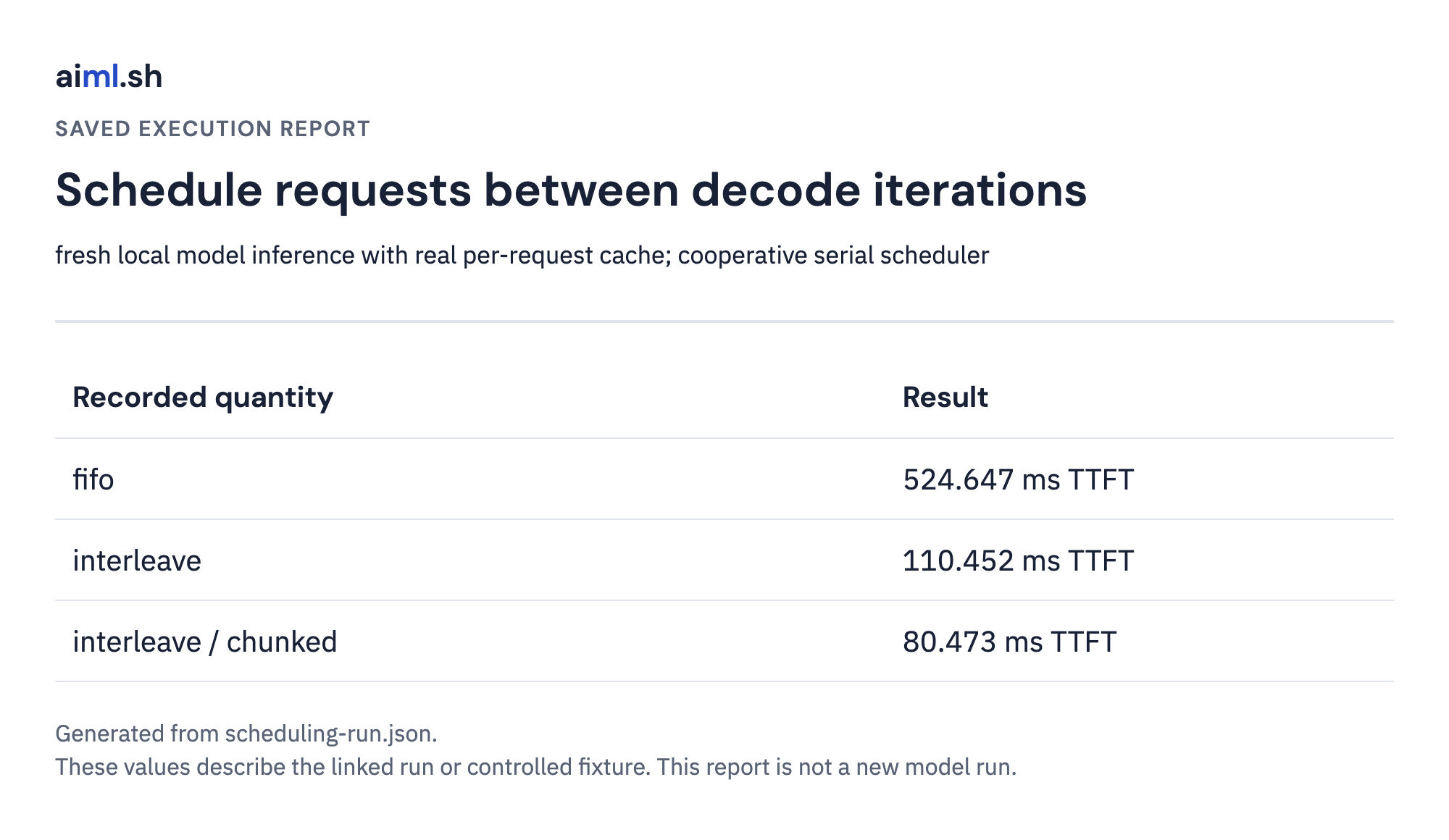
The real cooperative scheduler record runs FIFO, interleaving, and chunked prefill with actual per-request model caches. Its source uses serial forwards, so it is an interleaving experiment rather than an optimized continuous-batching engine.
Try a change and explain the result
Follow a short request arriving behind a long output in both schedules. Identify its queue delay and completion time. Change the output-length mix and predict whether the batching advantage grows or shrinks.
Read the explanation
Iteration boundaries allow finished sequences to leave and eligible waiting requests to join.
Integrate with an actual serving scheduler
Bound the queue, record scheduling delay separately, and test arrivals during execution. For production, use a serving engine with continuous batching rather than wrapping a blocking generate() call in an unbounded thread pool.
References
Sources checked October 24, 2026. Runtime-specific commands and results apply to the recorded versions; linked rolling documentation can change. The application scenarios are teaching examples, not claims about an author’s production incident.