When you need this. A shared inference service serves interactive code completions and background repository summaries. Counting every request equally lets long batch work occupy the service while interactive users wait. Implement separate admission and scheduling policies.
What you run. Actual queue and admission-policy implementation with a deterministic service-cost model. No authentication service, multi-tenant GPU deployment, or billing system.
This lesson builds on investigate inference tail latency with request records.
Separate admission from scheduling
Admission control decides whether work enters the system. Scheduling chooses which admitted work runs next. Deficit round robin (DRR) gives each tenant an accumulating service budget, subtracting a request’s estimated work when it runs.
The lab’s weighted input/output token cost is an application estimate, not an industry token unit. Its coefficient must be calibrated to the model and workload. Priority lanes express a service policy; they do not establish tenant authentication or a universal fairness definition.
MultiTenantScheduler implements tenant queues, token-budget accounting, priority selection, and a cache-capacity gate. Its execution times and occupancy are modeled. The real HTTP server earlier demonstrates actual bounded admission and 429 responses; this scheduler is not wired into that model engine.
Run the mixed-tenant queue
Download the lab from this page, extract it, and run these commands from its directory. The default command reads saved run records or runs the explicitly described local algorithm; it never downloads a model or calls a paid API.
python3 lab.py
python3 -m unittest -v test_lab.py
Read lab.py
"""Multi-tenant LLM inference scheduler with service-token deficit round-robin and KV-aware admission control."""
from __future__ import annotations
from collections import deque
from dataclasses import asdict, dataclass
import json
import math
from typing import Literal
PriorityClass = Literal["interactive", "batch"]
@dataclass(frozen=True)
class TenantQuota:
tenant_id: str
weight: float
burst_service_tokens: int
sustained_service_tokens_per_sec: int
priority_class: PriorityClass = "interactive"
def __post_init__(self) -> None:
if not self.tenant_id.strip():
raise ValueError("tenant_id must be non-empty")
if self.weight <= 0:
raise ValueError("weight must be positive")
if self.burst_service_tokens <= 0 or self.sustained_service_tokens_per_sec <= 0:
raise ValueError("token quotas must be positive")
@dataclass(frozen=True)
class InferenceRequest:
request_id: str
tenant_id: str
arrival_ms: int
prefill_tokens: int
decode_tokens: int
priority_class: PriorityClass
def service_tokens(self, decode_weight: int = 4) -> int:
if decode_weight <= 0:
raise ValueError("decode_weight must be positive")
return self.prefill_tokens + decode_weight * self.decode_tokens
def kv_blocks_required(self, block_tokens: int = 16) -> int:
return math.ceil((self.prefill_tokens + self.decode_tokens) / block_tokens)
@dataclass(frozen=True)
class ScheduledOutcome:
request_id: str
tenant_id: str
priority_class: PriorityClass
status_code: int
reason: str
service_tokens: int
ttft_ms: float
queue_wait_ms: float
kv_occupancy_ratio: float
class MultiTenantScheduler:
"""Schedules multi-tenant GPU inference requests using service-token DRR and KV admission watermarks."""
def __init__(
self,
quotas: list[TenantQuota],
*,
total_kv_blocks: int = 1600,
interactive_kv_watermark: float = 0.90,
batch_kv_watermark: float = 0.65,
max_interactive_wait_ms: float = 420.0,
max_batch_wait_ms: float = 3500.0,
decode_weight: int = 4,
base_quantum_tokens: int = 1200,
cluster_service_tokens_per_ms: float = 45.0,
scheduling_mode: Literal[
"service_token_drr", "request_count_fifo"
] = "service_token_drr",
enable_admission_control: bool = True,
) -> None:
if not quotas:
raise ValueError("At least one TenantQuota is required")
if not (0.0 < batch_kv_watermark <= interactive_kv_watermark <= 1.0):
raise ValueError(
"Watermarks must satisfy 0 < batch_kv_watermark <= interactive_kv_watermark <= 1"
)
self.quotas = {q.tenant_id: q for q in quotas}
self.total_kv_blocks = total_kv_blocks
self.interactive_kv_watermark = interactive_kv_watermark
self.batch_kv_watermark = batch_kv_watermark
self.max_interactive_wait_ms = max_interactive_wait_ms
self.max_batch_wait_ms = max_batch_wait_ms
self.decode_weight = decode_weight
self.base_quantum_tokens = base_quantum_tokens
self.cluster_service_tokens_per_ms = cluster_service_tokens_per_ms
self.scheduling_mode = scheduling_mode
self.enable_admission_control = enable_admission_control
def run_trace(self, requests: list[InferenceRequest]) -> list[ScheduledOutcome]:
ordered = sorted(requests, key=lambda r: (r.arrival_ms, r.request_id))
if self.scheduling_mode == "request_count_fifo":
return self._run_request_count_fifo(ordered)
return self._run_service_token_drr(ordered)
def _run_request_count_fifo(
self, ordered: list[InferenceRequest]
) -> list[ScheduledOutcome]:
"""Naive per-tenant 1-request round-robin without priority lanes or service-token accounting."""
queues: dict[str, deque[InferenceRequest]] = {
tid: deque() for tid in self.quotas
}
tenant_order = list(self.quotas.keys())
idx = 0
clock_ms = 0.0
active_releases: list[tuple[float, int]] = []
outcomes: list[ScheduledOutcome] = []
def used_blocks(now_ms: float) -> int:
return sum(blocks for rel_ms, blocks in active_releases if rel_ms > now_ms)
while idx < len(ordered) or any(queues.values()):
if not any(queues.values()) and idx < len(ordered):
clock_ms = max(clock_ms, float(ordered[idx].arrival_ms))
while idx < len(ordered) and ordered[idx].arrival_ms <= clock_ms:
req = ordered[idx]
queues[req.tenant_id].append(req)
idx += 1
dispatched = False
for tid in tenant_order:
if not queues[tid]:
continue
req = queues[tid].popleft()
active_releases = [
(rel, blk) for rel, blk in active_releases if rel > clock_ms
]
req_blocks = req.kv_blocks_required()
occ = (used_blocks(clock_ms) + req_blocks) / self.total_kv_blocks
svc_tokens = req.service_tokens(self.decode_weight)
wait_ms = max(0.0, clock_ms - req.arrival_ms)
if (
self.enable_admission_control
and occ > self.interactive_kv_watermark
):
outcomes.append(
ScheduledOutcome(
request_id=req.request_id,
tenant_id=req.tenant_id,
priority_class=req.priority_class,
status_code=429,
reason="shed_kv_watermark",
service_tokens=svc_tokens,
ttft_ms=0.0,
queue_wait_ms=round(wait_ms, 2),
kv_occupancy_ratio=round(occ, 4),
)
)
dispatched = True
continue
prefill_ms = max(8.0, req.prefill_tokens / 48.0)
exec_ms = svc_tokens / self.cluster_service_tokens_per_ms
ttft_ms = wait_ms + prefill_ms
active_releases.append((clock_ms + exec_ms * 5.5, req_blocks))
clock_ms += exec_ms
outcomes.append(
ScheduledOutcome(
request_id=req.request_id,
tenant_id=req.tenant_id,
priority_class=req.priority_class,
status_code=200,
reason="admitted",
service_tokens=svc_tokens,
ttft_ms=round(ttft_ms, 2),
queue_wait_ms=round(wait_ms, 2),
kv_occupancy_ratio=round(occ, 4),
)
)
dispatched = True
while idx < len(ordered) and ordered[idx].arrival_ms <= clock_ms:
queues[ordered[idx].tenant_id].append(ordered[idx])
idx += 1
if not dispatched and idx < len(ordered):
clock_ms = float(ordered[idx].arrival_ms)
return outcomes
def _run_service_token_drr(
self, ordered: list[InferenceRequest]
) -> list[ScheduledOutcome]:
"""Priority-separated weighted deficit round-robin measured in service tokens with KV admission shedding."""
interactive_q: dict[str, deque[InferenceRequest]] = {
tid: deque() for tid in self.quotas
}
batch_q: dict[str, deque[InferenceRequest]] = {
tid: deque() for tid in self.quotas
}
deficits: dict[str, float] = {tid: 0.0 for tid in self.quotas}
token_buckets: dict[str, float] = {
tid: float(q.burst_service_tokens) for tid, q in self.quotas.items()
}
last_refill_ms = 0.0
clock_ms = 0.0
idx = 0
active_releases: list[tuple[float, int]] = []
outcomes: list[ScheduledOutcome] = []
def refill_buckets(now_ms: float) -> None:
nonlocal last_refill_ms
dt_sec = max(0.0, (now_ms - last_refill_ms) / 1000.0)
if dt_sec <= 0.0:
return
for tid, quota in self.quotas.items():
updated = (
token_buckets[tid] + dt_sec * quota.sustained_service_tokens_per_sec
)
token_buckets[tid] = min(float(quota.burst_service_tokens), updated)
last_refill_ms = now_ms
def current_kv_blocks(now_ms: float) -> int:
return sum(blocks for rel_ms, blocks in active_releases if rel_ms > now_ms)
def queued_kv_blocks(lane: dict[str, deque[InferenceRequest]]) -> int:
return sum(req.kv_blocks_required() for q in lane.values() for req in q)
def pending_service_tokens(lane: dict[str, deque[InferenceRequest]]) -> int:
return sum(
req.service_tokens(self.decode_weight)
for q in lane.values()
for req in q
)
def admit_or_shed(
req: InferenceRequest, eval_ms: float
) -> tuple[bool, str, float]:
svc = req.service_tokens(self.decode_weight)
req_blocks = req.kv_blocks_required()
reserved_blocks = (
current_kv_blocks(eval_ms)
+ queued_kv_blocks(interactive_q)
+ (queued_kv_blocks(batch_q) if req.priority_class == "batch" else 0)
)
occ = (reserved_blocks + req_blocks) / self.total_kv_blocks
if not self.enable_admission_control:
return True, "admitted", occ
watermark = (
self.interactive_kv_watermark
if req.priority_class == "interactive"
else self.batch_kv_watermark
)
if occ > watermark:
return False, "shed_kv_watermark", min(occ, watermark)
lane_queues = (
interactive_q if req.priority_class == "interactive" else batch_q
)
estimated_wait_ms = (
pending_service_tokens(lane_queues) / self.cluster_service_tokens_per_ms
)
wait_limit = (
self.max_interactive_wait_ms
if req.priority_class == "interactive"
else self.max_batch_wait_ms
)
if estimated_wait_ms > wait_limit:
return False, "shed_queue_wait_slo", min(occ, watermark)
if req.priority_class == "batch" and token_buckets[req.tenant_id] < svc:
return False, "shed_tenant_token_quota", min(occ, watermark)
return True, "admitted", occ
def enqueue_arrivals(up_to_ms: float) -> None:
nonlocal idx
while idx < len(ordered) and ordered[idx].arrival_ms <= up_to_ms:
req = ordered[idx]
idx += 1
refill_buckets(float(req.arrival_ms))
eval_ms = max(clock_ms, float(req.arrival_ms))
admitted, reason, occ = admit_or_shed(req, eval_ms)
svc = req.service_tokens(self.decode_weight)
if not admitted:
outcomes.append(
ScheduledOutcome(
request_id=req.request_id,
tenant_id=req.tenant_id,
priority_class=req.priority_class,
status_code=429,
reason=reason,
service_tokens=svc,
ttft_ms=0.0,
queue_wait_ms=0.0,
kv_occupancy_ratio=round(occ, 4),
)
)
continue
token_buckets[req.tenant_id] = max(
0.0, token_buckets[req.tenant_id] - svc
)
target = (
interactive_q if req.priority_class == "interactive" else batch_q
)
target[req.tenant_id].append(req)
tenant_ids = list(self.quotas.keys())
while (
idx < len(ordered) or any(interactive_q.values()) or any(batch_q.values())
):
if (
not any(interactive_q.values())
and not any(batch_q.values())
and idx < len(ordered)
):
clock_ms = max(clock_ms, float(ordered[idx].arrival_ms))
enqueue_arrivals(clock_ms)
# Serve interactive lane first via weighted service-token DRR; only serve batch when interactive is empty.
active_lane = interactive_q if any(interactive_q.values()) else batch_q
if not any(active_lane.values()):
continue
dispatched_in_round = False
for tid in tenant_ids:
q = active_lane[tid]
if not q:
deficits[tid] = 0.0
continue
deficits[tid] += self.base_quantum_tokens * self.quotas[tid].weight
while q:
head = q[0]
svc = head.service_tokens(self.decode_weight)
if deficits[tid] < svc:
break
q.popleft()
deficits[tid] -= svc
refill_buckets(clock_ms)
active_releases = [
(rel, blk) for rel, blk in active_releases if rel > clock_ms
]
req_blocks = head.kv_blocks_required()
watermark = (
self.interactive_kv_watermark
if head.priority_class == "interactive"
else self.batch_kv_watermark
)
occ = (
current_kv_blocks(clock_ms) + req_blocks
) / self.total_kv_blocks
if self.enable_admission_control and occ > watermark:
outcomes.append(
ScheduledOutcome(
request_id=head.request_id,
tenant_id=head.tenant_id,
priority_class=head.priority_class,
status_code=429,
reason="shed_kv_watermark",
service_tokens=svc,
ttft_ms=0.0,
queue_wait_ms=round(
max(0.0, clock_ms - head.arrival_ms), 2
),
kv_occupancy_ratio=round(occ, 4),
)
)
dispatched_in_round = True
continue
wait_ms = max(0.0, clock_ms - head.arrival_ms)
prefill_ms = max(8.0, head.prefill_tokens / 48.0)
# Non-preemptive service: consume the full request work, exactly as the FIFO baseline.
exec_ms = svc / self.cluster_service_tokens_per_ms
step_advance_ms = exec_ms
ttft_ms = wait_ms + prefill_ms
active_releases.append((clock_ms + exec_ms * 5.5, req_blocks))
clock_ms += step_advance_ms
outcomes.append(
ScheduledOutcome(
request_id=head.request_id,
tenant_id=head.tenant_id,
priority_class=head.priority_class,
status_code=200,
reason="admitted",
service_tokens=svc,
ttft_ms=round(ttft_ms, 2),
queue_wait_ms=round(wait_ms, 2),
kv_occupancy_ratio=round(occ, 4),
)
)
dispatched_in_round = True
enqueue_arrivals(clock_ms)
if active_lane is batch_q and any(interactive_q.values()):
break
if active_lane is batch_q and any(interactive_q.values()):
break
if not dispatched_in_round:
needed = min(
(
(q[0].service_tokens(self.decode_weight) - deficits[tid])
/ self.quotas[tid].weight
for tid, q in active_lane.items()
if q
),
default=float(self.base_quantum_tokens),
)
boost = max(float(self.base_quantum_tokens), math.ceil(needed))
for tid, q in active_lane.items():
if q:
deficits[tid] += boost * self.quotas[tid].weight
return outcomes
def percentile(values: list[float], p: float) -> float:
if not values:
return 0.0
ordered = sorted(values)
idx = min(len(ordered) - 1, max(0, math.ceil((p / 100.0) * len(ordered)) - 1))
return round(ordered[idx], 2)
def build_noisy_neighbor_workload() -> tuple[list[TenantQuota], list[InferenceRequest]]:
quotas = [
TenantQuota(
tenant_id="tenant_chat_pro",
weight=2.0,
burst_service_tokens=48_000,
sustained_service_tokens_per_sec=180_000,
priority_class="interactive",
),
TenantQuota(
tenant_id="tenant_ide_assist",
weight=1.5,
burst_service_tokens=36_000,
sustained_service_tokens_per_sec=140_000,
priority_class="interactive",
),
TenantQuota(
tenant_id="tenant_batch_rag",
weight=1.0,
burst_service_tokens=28_000,
sustained_service_tokens_per_sec=60_000,
priority_class="batch",
),
]
requests: list[InferenceRequest] = []
# Tenant batch_rag floods the gateway at t=0..170ms with 18 heavy document-extraction requests.
for i in range(18):
requests.append(
InferenceRequest(
request_id=f"batch-{i:02d}",
tenant_id="tenant_batch_rag",
arrival_ms=i * 10,
prefill_tokens=3200,
decode_tokens=350,
priority_class="batch",
)
)
# Interactive tenants send short, latency-sensitive requests across t=5..365ms.
for i in range(24):
requests.append(
InferenceRequest(
request_id=f"chat-{i:02d}",
tenant_id="tenant_chat_pro",
arrival_ms=5 + i * 15,
prefill_tokens=280,
decode_tokens=90,
priority_class="interactive",
)
)
for i in range(18):
requests.append(
InferenceRequest(
request_id=f"ide-{i:02d}",
tenant_id="tenant_ide_assist",
arrival_ms=8 + i * 20,
prefill_tokens=420,
decode_tokens=60,
priority_class="interactive",
)
)
return quotas, requests
def summarize_outcomes(outcomes: list[ScheduledOutcome]) -> dict[str, object]:
interactive_ok = [
o
for o in outcomes
if o.priority_class == "interactive" and o.status_code == 200
]
batch_ok = [
o for o in outcomes if o.priority_class == "batch" and o.status_code == 200
]
shed = [o for o in outcomes if o.status_code == 429]
by_tenant: dict[str, dict[str, object]] = {}
for tid in sorted({o.tenant_id for o in outcomes}):
tenant_rows = [o for o in outcomes if o.tenant_id == tid]
admitted = [o for o in tenant_rows if o.status_code == 200]
rejected = [o for o in tenant_rows if o.status_code == 429]
by_tenant[tid] = {
"submitted": len(tenant_rows),
"admitted": len(admitted),
"shed_429": len(rejected),
"admitted_service_tokens": sum(o.service_tokens for o in admitted),
"p50_ttft_ms": percentile([o.ttft_ms for o in admitted], 50),
"p99_ttft_ms": percentile([o.ttft_ms for o in admitted], 99),
}
shed_reasons: dict[str, int] = {}
for row in shed:
shed_reasons[row.reason] = shed_reasons.get(row.reason, 0) + 1
return {
"total_requests": len(outcomes),
"admitted_requests": len(interactive_ok) + len(batch_ok),
"shed_429_requests": len(shed),
"interactive_p50_ttft_ms": percentile([o.ttft_ms for o in interactive_ok], 50),
"interactive_p99_ttft_ms": percentile([o.ttft_ms for o in interactive_ok], 99),
"batch_p99_ttft_ms": percentile([o.ttft_ms for o in batch_ok], 99),
"peak_kv_occupancy_ratio": round(
max((o.kv_occupancy_ratio for o in outcomes), default=0.0), 4
),
"shed_reasons": shed_reasons,
"tenants": by_tenant,
}
def simulate_noisy_neighbor() -> dict[str, object]:
quotas, workload = build_noisy_neighbor_workload()
naive_scheduler = MultiTenantScheduler(
quotas,
scheduling_mode="request_count_fifo",
enable_admission_control=False,
)
protected_scheduler = MultiTenantScheduler(
quotas,
scheduling_mode="service_token_drr",
enable_admission_control=True,
)
naive_outcomes = naive_scheduler.run_trace(workload)
protected_outcomes = protected_scheduler.run_trace(workload)
return {
"experiment": "multi-tenant-service-token-drr-and-admission-control",
"decode_weight": 4,
"interactive_ttft_slo_ms": 500.0,
"quotas": [asdict(q) for q in quotas],
"comparison": {
"request_count_no_admission": summarize_outcomes(naive_outcomes),
"service_token_drr_with_admission": summarize_outcomes(protected_outcomes),
},
"sample_decisions": [asdict(o) for o in protected_outcomes[:10]],
}
def main() -> None:
report = simulate_noisy_neighbor()
print(
json.dumps(
{
"execution_mode": "CPU algorithm with controlled inputs; any latency/capacity coefficients are assumptions",
**report,
},
indent=2,
)
)
if __name__ == "__main__":
main()This fixture compares a service policy under a fixed cost model. Improved interactive waiting may come with less admitted batch work. Inspect the per-tenant admission and wait records before calling the policy fair.
Inspect the complete local result
{
  "execution_mode": "CPU algorithm with controlled inputs; any latency/capacity coefficients are assumptions",
  "experiment": "multi-tenant-service-token-drr-and-admission-control",
  "decode_weight": 4,
  "interactive_ttft_slo_ms": 500.0,
  "quotas": [
    {
      "tenant_id": "tenant_chat_pro",
      "weight": 2.0,
      "burst_service_tokens": 48000,
      "sustained_service_tokens_per_sec": 180000,
      "priority_class": "interactive"
    },
    {
      "tenant_id": "tenant_ide_assist",
      "weight": 1.5,
      "burst_service_tokens": 36000,
      "sustained_service_tokens_per_sec": 140000,
      "priority_class": "interactive"
    },
    {
      "tenant_id": "tenant_batch_rag",
      "weight": 1.0,
      "burst_service_tokens": 28000,
      "sustained_service_tokens_per_sec": 60000,
      "priority_class": "batch"
    }
  ],
  "comparison": {
    "request_count_no_admission": {
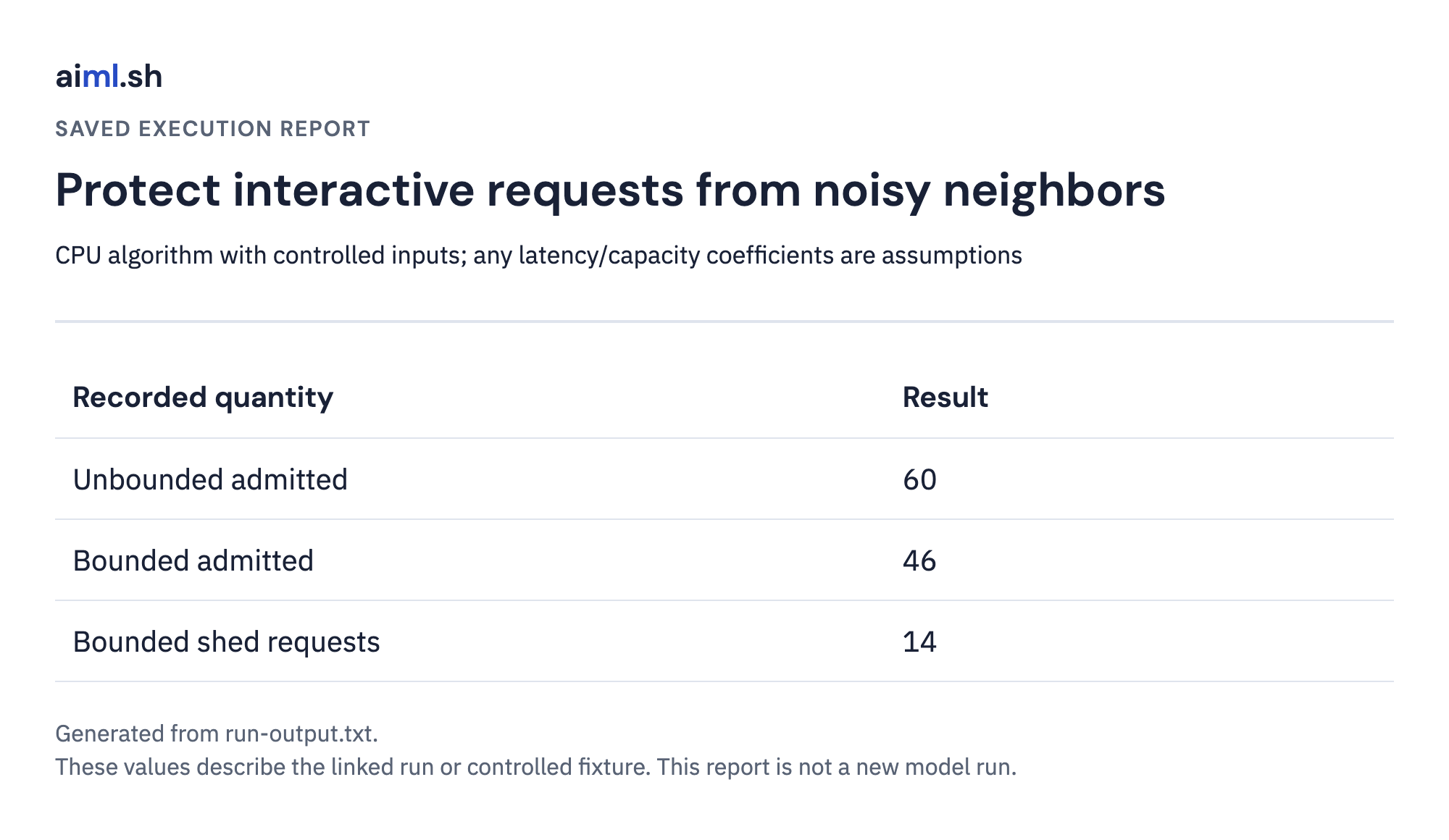
      "total_requests": 60,
      "admitted_requests": 60,
      "shed_429_requests": 0,
      "interactive_p50_ttft_ms": 1228.31,
      "interactive_p99_ttft_ms": 2093.0,
      "batch_p99_ttft_ms": 2125.56,
      "peak_kv_occupancy_ratio": 0.7275,
      "shed_reasons": {},
      "tenants": {
        "tenant_batch_rag": {
          "submitted": 18,
          "admitted": 18,
          "shed_429": 0,
          "admitted_service_tokens": 82800,
          "p50_ttft_ms": 1035.56,
          "p99_ttft_ms": 2125.56
        },
        "tenant_chat_pro": {
          "submitted": 24,
          "admitted": 24,
          "shed_429": 0,
          "admitted_service_tokens": 15360,
          "p50_ttft_ms": 1382.44,
          "p99_ttft_ms": 2093.0
        },
        "tenant_ide_assist": {
          "submitted": 18,
          "admitted": 18,
          "shed_429": 0,
          "admitted_service_tokens": 11880,
          "p50_ttft_ms": 1006.08,
          "p99_ttft_ms": 2006.08
        }
      }
    },
    "service_token_drr_with_admission": {
      "total_requests": 60,
      "admitted_requests": 46,
      "shed_429_requests": 14,
      "interactive_p50_ttft_ms": 222.08,
      "interactive_p99_ttft_ms": 358.97,
      "batch_p99_ttft_ms": 948.67,
      "peak_kv_occupancy_ratio": 0.65,
      "shed_reasons": {
        "shed_kv_watermark": 14
      },
      "tenants": {
        "tenant_batch_rag": {
          "submitted": 18,
          "admitted": 4,
          "shed_429": 14,
          "admitted_service_tokens": 18400,
          "p50_ttft_ms": 764.22,
          "p99_ttft_ms": 948.67
        },
        "tenant_chat_pro": {
          "submitted": 24,
          "admitted": 24,
          "shed_429": 0,
          "admitted_service_tokens": 15360,
          "p50_ttft_ms": 211.67,
          "p99_ttft_ms": 322.78
        },
        "tenant_ide_assist": {
          "submitted": 18,
          "admitted": 18,
          "shed_429": 0,
          "admitted_service_tokens": 11880,
          "p50_ttft_ms": 268.31,
          "p99_ttft_ms": 358.97
        }
      }
    }
  },
  "sample_decisions": [
    {
      "request_id": "batch-00",
      "tenant_id": "tenant_batch_rag",
      "priority_class": "batch",
      "status_code": 200,
      "reason": "admitted",
      "service_tokens": 4600,
      "ttft_ms": 66.67,
      "queue_wait_ms": 0.0,
      "kv_occupancy_ratio": 0.1388
    },
    {
      "request_id": "batch-04",
      "tenant_id": "tenant_batch_rag",
      "priority_class": "batch",
      "status_code": 429,
      "reason": "shed_kv_watermark",
      "service_tokens": 4600,
      "ttft_ms": 0.0,
      "queue_wait_ms": 0.0,
      "kv_occupancy_ratio": 0.65
    },
    {
      "request_id": "batch-05",
      "tenant_id": "tenant_batch_rag",
      "priority_class": "batch",
      "status_code": 429,
      "reason": "shed_kv_watermark",
      "service_tokens": 4600,
      "ttft_ms": 0.0,
      "queue_wait_ms": 0.0,
      "kv_occupancy_ratio": 0.65
    },
    {
      "request_id": "batch-06",
      "tenant_id": "tenant_batch_rag",
      "priority_class": "batch",
      "status_code": 429,
      "reason": "shed_kv_watermark",
      "service_tokens": 4600,
      "ttft_ms": 0.0,
      "queue_wait_ms": 0.0,
      "kv_occupancy_ratio": 0.65
    },
    {
      "request_id": "batch-07",
      "tenant_id": "tenant_batch_rag",
      "priority_class": "batch",
      "status_code": 429,
      "reason": "shed_kv_watermark",
      "service_tokens": 4600,
      "ttft_ms": 0.0,
      "queue_wait_ms": 0.0,
      "kv_occupancy_ratio": 0.65
    },
    {
      "request_id": "batch-08",
      "tenant_id": "tenant_batch_rag",
      "priority_class": "batch",
      "status_code": 429,
      "reason": "shed_kv_watermark",
      "service_tokens": 4600,
      "ttft_ms": 0.0,
      "queue_wait_ms": 0.0,
      "kv_occupancy_ratio": 0.65
    },
    {
      "request_id": "batch-09",
      "tenant_id": "tenant_batch_rag",
      "priority_class": "batch",
      "status_code": 429,
      "reason": "shed_kv_watermark",
      "service_tokens": 4600,
      "ttft_ms": 0.0,
      "queue_wait_ms": 0.0,
      "kv_occupancy_ratio": 0.65
    },
    {
      "request_id": "batch-10",
      "tenant_id": "tenant_batch_rag",
      "priority_class": "batch",
      "status_code": 429,
      "reason": "shed_kv_watermark",
      "service_tokens": 4600,
      "ttft_ms": 0.0,
      "queue_wait_ms": 0.0,
      "kv_occupancy_ratio": 0.65
    },
    {
      "request_id": "chat-00",
      "tenant_id": "tenant_chat_pro",
      "priority_class": "interactive",
      "status_code": 200,
      "reason": "admitted",
      "service_tokens": 640,
      "ttft_ms": 105.22,
      "queue_wait_ms": 97.22,
      "kv_occupancy_ratio": 0.1537
    },
    {
      "request_id": "batch-11",
      "tenant_id": "tenant_batch_rag",
      "priority_class": "batch",
      "status_code": 429,
      "reason": "shed_kv_watermark",
      "service_tokens": 4600,
      "ttft_ms": 0.0,
      "queue_wait_ms": 0.0,
      "kv_occupancy_ratio": 0.65
    }
  ]
}
This image is an application-generated report of the saved program result, not a new inference run. Open the full-resolution report or read the raw result.
Define who waits and who is rejected
Protecting an interactive lane can reduce batch throughput or starve background work unless the policy reserves service for it. Rejecting early preserves capacity but pushes retry and backoff behavior onto clients. Estimated work should be reconciled with actual usage rather than trusted as a billable measurement.
Unequal request work. Long prompts consume more service budget than short completions in the fixture. The DRR path must charge and execute their full modeled work; it cannot discard the remainder of a batch request.
Admission capacity. Requests that would cross a watermark are shed. Their attempted occupancy remains in the decision record rather than being clamped to make the policy look safe.
Read the executable checks
"""Unit and failure-mode tests for multi-tenant fairness, priority queues, and admission limits."""

from __future__ import annotations

import unittest

from lab import (
    InferenceRequest,
    MultiTenantScheduler,
    TenantQuota,
    build_noisy_neighbor_workload,
    simulate_noisy_neighbor,
    summarize_outcomes,
)


class MultiTenantFairnessTest(unittest.TestCase):
    def test_service_token_accounting_weights_decode_higher_than_prefill(self) -> None:
        short_chat = InferenceRequest(
            request_id="chat-1",
            tenant_id="tenant_chat_pro",
            arrival_ms=0,
            prefill_tokens=250,
            decode_tokens=80,
            priority_class="interactive",
        )
        long_rag = InferenceRequest(
            request_id="rag-1",
            tenant_id="tenant_batch_rag",
            arrival_ms=0,
            prefill_tokens=3200,
            decode_tokens=350,
            priority_class="batch",
        )
        self.assertEqual(short_chat.service_tokens(decode_weight=4), 570)
        self.assertEqual(long_rag.service_tokens(decode_weight=4), 4600)
        self.assertGreater(
            long_rag.service_tokens(4) / short_chat.service_tokens(4), 8.0
        )

    def test_service_token_drr_meets_interactive_ttft_slo_under_batch_flood(
        self,
    ) -> None:
        report = simulate_noisy_neighbor()
        protected = report["comparison"]["service_token_drr_with_admission"]
        self.assertLessEqual(protected["interactive_p99_ttft_ms"], 500.0)
        self.assertEqual(protected["tenants"]["tenant_chat_pro"]["shed_429"], 0)
        self.assertEqual(protected["tenants"]["tenant_ide_assist"]["shed_429"], 0)
        self.assertGreater(protected["tenants"]["tenant_batch_rag"]["shed_429"], 0)

    def test_request_count_fairness_lets_long_prompts_starve_short_chats(self) -> None:
        quotas, workload = build_noisy_neighbor_workload()
        naive = MultiTenantScheduler(
            quotas,
            scheduling_mode="request_count_fifo",
            enable_admission_control=False,
        )
        protected = MultiTenantScheduler(
            quotas,
            scheduling_mode="service_token_drr",
            enable_admission_control=True,
        )
        naive_summary = summarize_outcomes(naive.run_trace(workload))
        protected_summary = summarize_outcomes(protected.run_trace(workload))

        # Under 1-for-1 request-count scheduling, 4,600-service-token batch jobs block 570-token chats.
        self.assertGreater(naive_summary["interactive_p99_ttft_ms"], 1800.0)
        self.assertLessEqual(protected_summary["interactive_p99_ttft_ms"], 500.0)

    def test_missing_admission_limit_causes_cluster_queue_collapse(self) -> None:
        quotas, workload = build_noisy_neighbor_workload()
        unbounded = MultiTenantScheduler(
            quotas,
            total_kv_blocks=1024,
            scheduling_mode="request_count_fifo",
            enable_admission_control=False,
        )
        guarded = MultiTenantScheduler(
            quotas,
            total_kv_blocks=1024,
            interactive_kv_watermark=0.90,
            batch_kv_watermark=0.65,
            scheduling_mode="service_token_drr",
            enable_admission_control=True,
        )
        unbounded_summary = summarize_outcomes(unbounded.run_trace(workload))
        guarded_summary = summarize_outcomes(guarded.run_trace(workload))

        # Without KV watermark shedding, peak KV occupancy exceeds 1.0 (OOM/preemption thrash).
        self.assertGreater(unbounded_summary["peak_kv_occupancy_ratio"], 1.0)
        self.assertLessEqual(guarded_summary["peak_kv_occupancy_ratio"], 0.90)
        self.assertGreater(guarded_summary["shed_429_requests"], 0)


class ServiceTimeAccountingTests(unittest.TestCase):
    def test_batch_service_is_not_discarded_after_one_slice(self):
        quota = TenantQuota("tenant", 1, 100000, 100000, "batch")
        requests = [
            InferenceRequest("a", "tenant", 0, 4800, 300, "batch"),
            InferenceRequest("b", "tenant", 0, 4800, 300, "batch"),
        ]
        scheduler = MultiTenantScheduler(
            [quota],
            total_kv_blocks=100000,
            enable_admission_control=False,
            cluster_service_tokens_per_ms=30,
        )
        outcomes = scheduler.run_trace(requests)
        self.assertEqual(len(outcomes), 2)
        self.assertGreaterEqual(outcomes[1].queue_wait_ms, 200)


if __name__ == "__main__":
    unittest.main()


class GuardBoundaryTests(unittest.TestCase):
    def test_rejects_invalid_boundary_inputs_with_specific_reason(self):
        import lab
        cases = [('TenantQuota("",1,1,1)', 'tenant_id'), ('TenantQuota("x",0,1,1)', 'weight must'), ('TenantQuota("x",1,0,1)', 'token quotas'), ('InferenceRequest("x","x",0,1,1,"interactive").service_tokens(0)', 'decode_weight'), ('MultiTenantScheduler([])', 'At least one'), ('MultiTenantScheduler([TenantQuota("x",1,1,1)],batch_kv_watermark=1,interactive_kv_watermark=0.5)', 'Watermarks must')]
        for code, reason in cases:
            with self.subTest(code=code):
                with self.assertRaisesRegex((ValueError, MemoryError, KeyError, RuntimeError), reason):
                    exec(code, vars(lab).copy())
Try a change and explain the result
Follow a batch and an interactive request through admission and scheduling separately. Change a tenant weight, then compare admitted work and wait time. Explain which fairness objective your change serves and who pays for it.
Read the explanation
Admission limits accepted work. Scheduling chooses the service order among accepted requests.
Apply quotas at an authenticated boundary
Authenticate tenants before applying quotas. Bound queue size and wait time, support cancellation, and return retry guidance appropriate to the service. Load-test mixed prompt and output lengths; do not declare fairness from one fixture.
References
Sources checked October 24, 2026. Runtime-specific commands and results apply to the recorded versions; linked rolling documentation can change. The application scenarios are teaching examples, not claims about an author’s production incident.